

|
||||
|---|---|---|---|---|
| Free Download | ||||

|
|
Image file | ||
Drawing a cow is really easy with this tutorial! You’ll go step by step and get a fantastic result.
⚠️ Grab pencil, drawing pencil, eraser and colors and get to work!
Welcome to our delightful cow drawing tutorial, designed especially for young artists and beginners! In this step-by-step guide, you’ll learn how to easily draw a charming cow, mastering basic shapes and lines. This tutorial is perfect for children and beginners who are eager to explore their creative skills.
Our approach focuses on using simple geometric shapes to build the cow’s form, making it accessible for those just starting out. By following these easy instructions, you’ll not only create a beautiful drawing but also gain confidence in your artistic abilities.
Whether you’re a parent guiding your child or a budding artist yourself, this tutorial will help you draw a cow with ease and enjoyment. So grab your pencils, and let’s get started on this fun and educational journey!
What You Will Need
- A4 drawing paper or sketchpad
- 2B pencil for initial sketching
- 4B pencil for darker outlines
- Eraser for removing guidelines
- Black colored pencil for final outlines
- Brown, black, and pink colored pencils for coloring
- Pencil sharpener

Step 1: Head and mouth
Start by sketching the cow’s head and mouth. Position two circles on the right side of your paper. Use a 2B pencil to draw a slightly larger circle for the head and, diagonally below it, a smaller one for the mouth. These circles will serve as guides to outline the cow’s face.
Tip: Don’t press too hard, as you’ll need to erase these lines later.

Step 2: Hull
Next, create the cow’s hull. Draw a rectangular shape to the left of the head, making sure it has rounded corners for a softer look. The rectangle should taper slightly at the bottom, giving the body a more natural appearance.
Use light strokes so you can adjust the shape as needed.

Step 3: Horns, tail and limbs
Now, let’s add some key features: the horns, tail, and limbs. Connect the head to the torso using a gentle curve. Add horns pointing forward and a long tail curving to the side. For the legs, mark the joints with small circles and connect them using straight lines. Finish by sketching the hooves at the bottom.
Tip: Keep the proportions in mind to maintain balance in your drawing.

Step 4: First final contours
Begin defining your cow with the first final contours. Use a darker pencil to trace the back line and tail, shaping the side view of the head with the horns. Connect the head and mouth circles to form the neck and face. For the legs, connect the torso to the joint circles, giving them a more defined shape.
Work slowly to ensure clean lines.

Step 5: Udder and face
It’s time to add facial features and refine other details. Draw an eye and outline the nose on the cow’s face. Continue by completing the legs and using a sweeping line for the belly. Use the rectangular guide for reference. Shape the tail with a tassel and illustrate the udder beneath the belly.
These small details bring your cow to life!

Step 6: Ears and more legs
Give your cow its ear by sketching a simple oval shape on the side of the head. Add the opposite legs, ensuring they align with the first pair. These additions help complete the cow’s form.
Remember, symmetry is key in making the drawing look realistic.

Step 7: Remove guides
With most of the cow completed, it’s time to tidy up. Use an eraser to gently remove any unnecessary guidelines that distract from the overall picture. This will make your cow drawing appear cleaner and more polished.
Tip: Be careful not to erase too much of the essential outline.

Step 8: Coloring
The final step is to add color to your cow. Choose a pink hue for the udder and use brown and black for the cow’s coat, following the pattern shown in the guide. Feel free to experiment with different colors and patterns for a unique touch.
Tip: Layer the colors gradually for a richer appearance.
More Template Ideas


Your Cow Drawing Is Complete!
Congratulations on completing your cow drawing! We hope you enjoyed the process and are proud of your artistic creation. Drawing is a wonderful way to express yourself, and with each practice, you’ll continue to improve.
Feel free to explore our other tutorials, like drawing horses or sheep, to expand your skills and creativity. Keep practicing and have fun on your artistic journey!
Tips for an Even Better Cow Drawing
Three details turn a generic four-legged animal into an unmistakable cow: the black-and-white spot pattern, the broad muzzle with two large nostrils, and the visible udder on a dairy cow. Get those right and the rest of the drawing falls into place.
The spots are the trickiest part. Real cow spots (Holstein-style) are never round circles or evenly placed. They’re irregular, blob-shaped patches with curved edges that flow into each other – some big, some tiny, some long and stretched. The pattern should look random, with one or two big spots dominating the body and several smaller ones scattered around. The face usually has its own clearly defined patches, often around the eyes or on the forehead.
The muzzle is wide, almost square in shape when seen from the front, with two large oval nostrils that take up most of the snout. A small horizontal line for the mouth and you’re done. Cow noses are not the small triangle of a dog or cat – they’re prominent.
For a dairy cow, draw the udder as a soft pink-cream pouch hanging between the back legs, with four small teats pointing downward. Don’t make it too small – an undersized udder looks awkward.
The horns (when drawn) are short, curved, and emerge from just above the ears. They should be uneven and slightly asymmetrical. Many dairy breeds are also drawn without horns – both styles are valid.
Cow Breed Variations
One body plan, many breeds:
- Holstein (classic dairy): White body with bold black patches. The most universally recognized cow. Often drawn with a pink udder.
- Jersey cow: Smaller, lighter brown body with cream-tan undertones, large doe-like eyes, no spots. Sweet and elegant.
- Highland cow: Long shaggy red-brown coat covering the eyes, long curved horns sweeping outward, sturdy legs. Hairy and charming.
- Texas Longhorn: Tan or red-brown body with white face, and most importantly – massive horns that span wider than the body itself. Iconic American.
- Brown Swiss: Solid greyish-brown body, soft eyes, slightly larger frame than Holstein. Calm and dignified.
- Calf (baby cow): Smaller body with proportionally bigger head, large dark eyes, wobbly long legs, soft spotting that’s less defined than on adults.
- Bull: Heavier muscular shoulders and neck, larger horns, ring through the nose, more aggressive posture. Markedly different silhouette from a cow.
- Cartoon storybook cow: Big round eyes with long lashes, oversized smile, exaggerated black-and-white spots, often a bell around the neck.
Pose Variations
- Grazing: Head down, mouth touching the grass, body horizontal. The classic peaceful pose.
- Lying down (resting): Cow folded with legs tucked underneath, chewing cud. Very calm.
- Looking over a fence: Only the head and front shoulders visible, body hidden behind a wooden fence. Curious expression.
- Mooing: Head tilted up, mouth wide open, soft “moo” lettering nearby. Dynamic and playful.
- Cow with calf: Mother cow standing tall, baby calf nestled against her side or nursing.
- Walking: Three-quarter view, two legs visibly forward and two back, slight head sway. Adds motion.
- Jumping over the moon: Storybook nursery rhyme reference – cow mid-leap over a crescent moon. Always charming.
Farm Scene Compositions
- Green pasture: Rolling hills, blue sky with scattered clouds, a few tufts of yellow wildflowers, the cow grazing peacefully. Always reads as “countryside.”
- Inside the barn: Wooden stalls, hay bales, soft golden light from a high window. The cow stands in straw.
- At the milking station: Cow being milked by a farmer with a small wooden stool and a metal bucket. Old-fashioned and warm.
- By the watering trough: Cow drinking from a metal trough, with a few chickens nearby for variety.
- Sunset silhouette: Black cow silhouette against an orange-pink sunset sky, dark fence line at the bottom. Atmospheric.
- Cow with bell: Alpine-style cow with a large brass bell on a leather collar, mountain background.
Color Palettes for Cows
- Classic Holstein: Pure white body, deep black patches, pink-cream udder, light pink muzzle, black hooves.
- Warm Jersey: Light caramel-brown body, cream face and belly, dark brown hooves, soft pink nose.
- Highland rust: Deep red-brown shaggy fur, slightly golden highlights, pale cream horns, almost-hidden dark eyes.
- Storybook pastel: Pale grey body with soft lavender spots, baby-pink udder, mint-green grass. Nursery-perfect.
- Old-fashioned farm: Slightly muted black and cream tones, beige fields, weathered wooden fences. Vintage feel.
Common Mistakes to Avoid
1. The spots are perfect circles. Real cow spots are irregular blobs, never circles. Forced circular spots make the drawing look like a costume.
2. Symmetric spot pattern. The left side of a cow never matches the right. Force-fitting symmetry kills realism.
3. Forgetting the udder. A dairy cow without an udder reads as a bull or steer. Even a small udder shape is enough.
4. The muzzle is too small. Cow noses are wide and prominent. A tiny muzzle makes the face look squished.
5. The legs are too short. Cows have surprisingly long, slim legs that take up about half the height. Stubby legs read as “baby calf.”
6. No tail. The tail is small but essential – a long thin line ending in a tuft of hair (called a switch). Without it, the cow looks unfinished.
7. The horns are too symmetric or too pointed. Cow horns curve gently outward and slightly upward, never sharp like an antelope.
Frequently Asked Questions About Drawing a Cow
What type of pencil is best for sketching the cow?
A 2B pencil is ideal for sketching as it provides a good balance between hard and soft lead, allowing for easy erasing and adjustments.
How can I ensure my cow drawing is proportional?
Start with light guidelines using basic shapes like circles and rectangles. These help maintain proportions before adding details.
Is it okay to use different colors for my cow?
Absolutely! Feel free to experiment with different colors and patterns to make your cow unique and reflect your personal style.
How can I make my drawing look more realistic?
Focus on adding details like the texture of the fur, shadows, and highlights, which can bring depth and realism to your drawing.
What should I do if I make a mistake?
Don’t worry! Use an eraser to gently remove any mistakes and redraw the section. Art is all about practice and improvement.
Take a picture and send it to show@colomio.com – we publish it on www.colomio.com!
All tutorials and images are copyrighted by happycolorz GmbH. Interested in using it? Please send a mail to info@colomio.com.
More ideas for drawing
-

Airplane drawing -

Plane drawing easy -

Apple drawing -

Bicycle drawing -

Ship drawing -

Car drawing -

Car drawing easy -

Cat drawing -
Cow drawing -

Dinosaur drawing -

Dog drawing -

Puppy drawing -

Dragon drawing -

Digger drawing -

Fairy drawing -

Giraffe drawing -

Lion drawing -

Mermaid drawing -

Moon drawing -

Motorcyle drawing -

Penguin drawing -

Pig zeichnen (einfach) -

Princess drawing -

Reindeer drawing -

Rooster drawing -

Santa Claus drawing -

Shark drawing -

Sheep drawing -

Strawberry drawing -

Sunflower drawing -

Tiger drawing -

Tractor drawing -

Train drawing -

Tree drawing -

Tree drawing easy -

Tulip drawing -

Turtle drawing -

Unicorn drawing -

Unicorn drawing easy -

Witch drawing
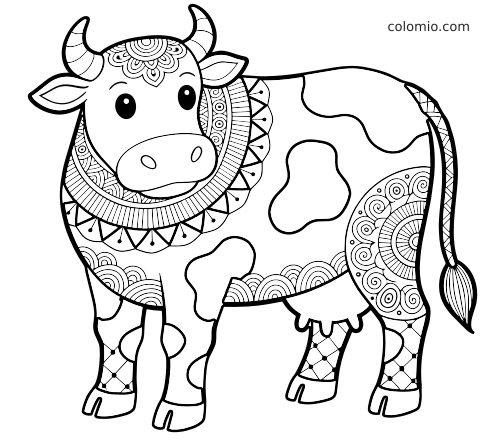
Print our free printable cow coloring pages — ready-to-print line art, no signup.
More Crafting Ideas
-

Bee craft -

How to Make a Paper Boat -

How to make an envelope -

Ladybug Craft -

Origami Boat -

Butterfly Craft