
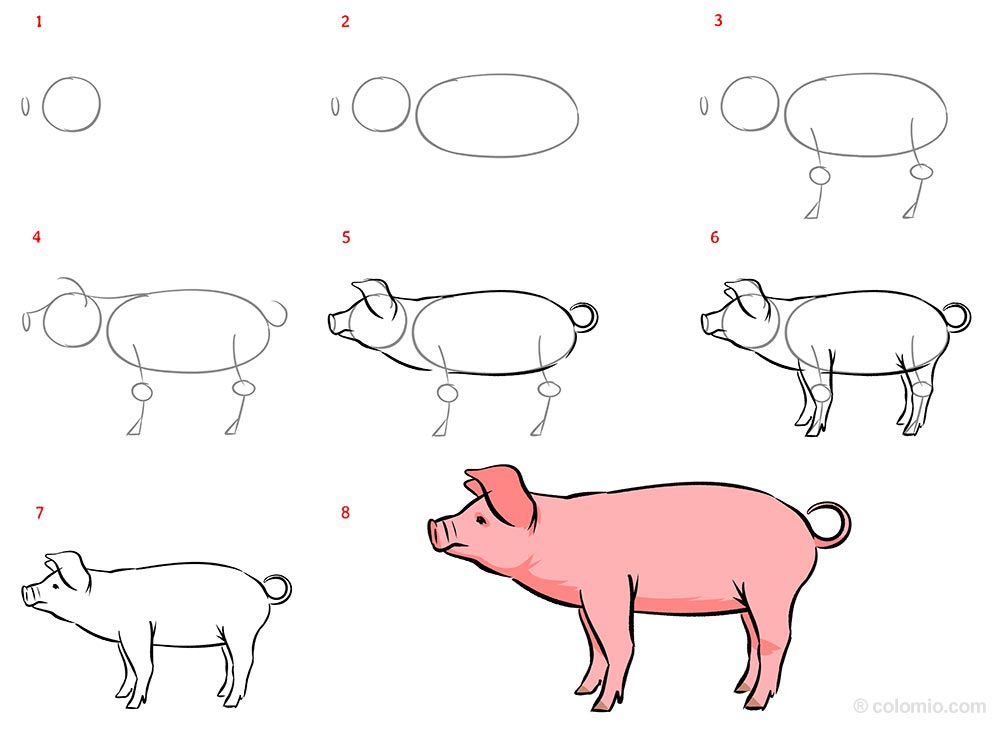
Drawing a pig is not difficult, but a few simple tricks can help make it look extra realistic and lifelike. With this step-by-step tutorial, you can draw a great pig and have a great template for a farm or fun menu design.
For this drawing you will need a pencil, an eraser, a drawing pencil and good Crayons.
Welcome to our step-by-step guide on how to draw a pig! This tutorial is perfect for children and beginner artists, particularly those aged 5 and up. By following our simple instructions, you’ll learn how to use basic shapes and lines to create a charming pig drawing. We will use a combination of freehand sketching and careful detailing to bring your pig to life.
This guide is designed to be both educational and fun, helping young artists develop their drawing skills while enjoying the process. Whether you’re a budding artist or just looking for a creative activity, this tutorial will guide you through each step with ease, ensuring that you achieve a delightful and realistic pig drawing by the end.
What You Will Need
- 2B pencil for sketching the initial shapes
- HB pencil for detailing and final contours
- Eraser for correcting and cleaning up guidelines
- Pink, gray, and black colored pencils for coloring
- A4 drawing paper for a comfortable workspace
- Sharpener to keep your pencils ready

Step 1: Head and trunk
First, let’s start with the head and trunk. Use your 2B pencil to draw a circle for the pig’s head; don’t worry if it’s not perfectly round, a freehand circle will add character to your drawing. Then, draw a small oval overlapping the bottom part of the circle to represent the nose.
Tip: Keep your lines light so they are easy to adjust later.

Step 2: Hull
Next, sketch the pig’s body using an elongated oval shape. Position this oval slightly overlapping the head circle to ensure the head and body are connected. This will serve as the basic structure for your pig’s body.
Tip: Adjust the size of the oval depending on how big you want your pig to be.

Step 3: Limbs
Now, let’s add the limbs. Draw four lines extending from the body for the legs, making sure they look natural and balanced. Use small circles at the joints to indicate where the knees and ankles would be, and sketch out simple shapes for the hooves.
Tip: Position the legs so the pig appears to be standing comfortably.

Step 4: Ears, neck and tail
With the basic shapes in place, it’s time to refine the pig’s features. Draw the ears by adding two small triangles on top of the head circle. Sketch a short line for the neck, and don’t forget the tail! A curly line will do the trick here.
Tip: Keep the ears and tail proportionate to the body for a realistic look.

Step 5: First final contours
Now that the basic outline is ready, switch to your HB pencil for more refined contours. Start by carefully going over the head and body, adding details to the ears and enhancing the curly tail. This will give your pig a more defined and polished appearance.
Tip: Use varying pressure with your pencil to create depth in the outlines.

Step 6: Legs and claws
Complete the legs and hooves using your drawing pencil, paying attention to the details that give the pig its characteristic look. Make sure the legs appear strong and capable of supporting the pig’s weight.
Tip: Smooth, flowing lines will help make the limbs look more natural.

Step 7: Eyes and face
It’s time to bring your pig’s face to life! Draw the eyes, nostrils, and a happy smile. Add gentle skin folds around the mouth to give your pig personality. Once satisfied, carefully erase any remaining guidelines and pencil marks.
Tip: A soft eraser works best for cleaning up without smudging.

Step 8: Coloring
Finally, add color to your pig using pink, gray, and black colored pencils. Use pink for the body, gray for shading, and black for details like the eyes and nostrils. To make your pig look more realistic, apply hatching to create shadows and depth.
Tip: Layering colors can add richness and vibrancy to your drawing.
More Template Ideas

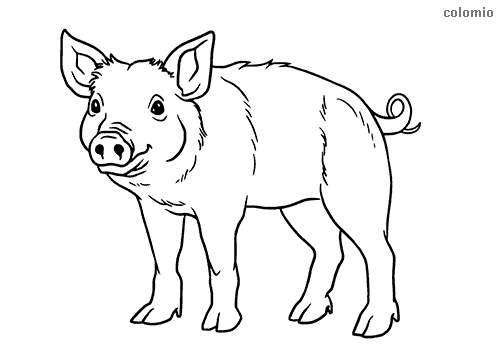

Your Pig Drawing Is Complete!
Congratulations on completing your pig drawing! We hope you enjoyed learning how to draw this adorable animal step by step. Don’t forget to display your artwork proudly or share it with friends and family.
If you’re eager to continue your drawing journey, check out our other tutorials on farm animals and more. Keep practicing, and remember, every drawing starts with a simple line!
Tips for an Even Better Pig Drawing
Three tiny details make a pig instantly readable: the flat round snout with two nostrils, the tightly curled tail, and the upright triangular ears. Skip any of these and the drawing starts to look like a generic farm animal.
The snout is the most signature feature. Draw it as a soft oval pressed flat against the front of the face, almost like the pig is pushing it against glass. Inside the oval, two small upward-pointing ovals are the nostrils – never just two dots. The snout is usually a slightly different shade than the rest of the face (a touch pinker) to make it stand out.
The tail is the most fun part to draw. It should be a tight spiral curl, like a tiny corkscrew, and should sit clearly above the back end – never drooping. A loose squiggle reads as “dog tail” instead of pig tail.
The ears come in two main shapes: pointed triangular ears that stand straight up (most common in cartoon pigs), or large floppy ears that fold forward over the eyes (typical of certain real breeds, very cute). Pick one style and stick with it across the drawing.
The body should be plump and rounded but not a perfect circle – slightly longer than tall, with a clear hump where the shoulders meet the head. The legs are short and sturdy, ending in cloven hooves drawn as a small inverted V.
Pig Variations
Same body plan, very different pigs:
- Cartoon pink pig: Bright bubblegum-pink body, big round eyes, big curly tail, oversized snout. The Peppa-Pig storybook style.
- Realistic farm pig: Pale pink-and-cream body with sparse white hairs, smaller eyes, more proportional snout. A working farm animal.
- Piglet (baby): Smaller body with relatively bigger head and ears, oversized eyes, tiny stubby legs. Always wins hearts.
- Pot-bellied pig (mini pig): Round pot belly nearly touching the ground, short stubby legs, sleeker face. Often kept as a pet.
- Wild boar: Brown-grey shaggy fur, two visible tusks pointing up from the lower jaw, longer snout, ears smaller and more pointed. Tougher and wilder.
- Black or spotted pig: Dark brown or black body, sometimes with white patches (like a Berkshire or Hampshire breed). Striking and realistic.
- Hairless mini pig in clothes: Pure pink body wearing a tiny sweater or bandana. The internet-darling style.
Pig Scenes & Compositions
- Pig in the mud: Plump pig sitting in a brown puddle with droplets splashing up around it. Big happy grin. Pure farmyard joy.
- Pig with apple: Pig holding a red apple in its snout or about to bite into one on the ground. Classic farm storybook image.
- Mother pig with piglets: Big sow lying on her side with 4–6 small piglets nursing or napping against her belly. Heart-melting.
- Pig in farmer overalls: A pig wearing tiny denim overalls and a straw hat. Children’s book gold.
- Pig in the sty: Wooden fence in the background, hay scattered around, a feeding trough in the foreground.
- Pig flying with balloons: “When pigs fly” literal joke – pig holding a bunch of colorful balloons, lifted off the ground.
- Three Little Pigs scene: Three pigs of slightly different sizes, each in front of a different house (straw, sticks, bricks).
Color Palettes for Pigs
- Classic cartoon pink: Bubblegum pink body, hot-pink snout and ears, black eyes, white highlights. Bright and cheerful.
- Realistic farm: Pale pink with cream-yellow undertones, slightly darker pink ears and snout, soft brown shading.
- Storybook pastel: Soft peachy pink, mint-green grass background, baby-blue sky. Nursery-perfect.
- Wild boar dramatic: Earthy browns and greys, dirty cream tusks, dark forest background. Rugged and atmospheric.
- Spotted pig: Mostly white body with random black or brown patches, pink belly, dark hooves. Real-breed authentic.
Adding Personality to Your Pig
A pig face becomes memorable with just three small touches:
- A small grin at the corner of the snout suggests cheerfulness.
- Rosy cheek circles right behind the snout add a friendly, warm feeling.
- Tiny eyelashes on female pigs (like Peppa) instantly differentiate the character.
- A single straw of hay sticking out of the corner of the mouth = country-pig charm.
- A flower behind the ear = sweet storybook style.
Common Mistakes to Avoid
1. The snout is round instead of flat. A pig snout is pressed flat against the face. A round, dog-like nose ruins the character immediately.
2. The nostrils are dots. Two small upward-pointing ovals are correct – round dots make the snout look like a button.
3. The tail is too straight or too long. Pig tails are short, tightly curled, and held high. A long droopy tail belongs to a different animal.
4. Forgetting the cloven hoof. Pig feet end in two small hoof points (cloven hooves), drawn as an inverted V. Solid round feet read as paws.
5. The body is a perfect circle. Pigs are oval – longer than tall – with a clear shoulder hump. A round ball-body looks unnatural.
6. The ears point sideways. Pig ears either stand up triangular or fold forward. Sideways ears look like they belong on a deer.
Frequently Asked Questions About Drawing a Pig
What type of paper is best for drawing?
A4 drawing paper is recommended as it provides a smooth surface that’s ideal for pencil work.
How do I make the pig look more realistic?
Use shading techniques like hatching to create shadows and depth, giving the pig a more three-dimensional appearance.
What if my pig’s proportions are off?
No worries! Adjust the shapes and lines as you go. The beauty of art is that it can be unique and personal.
Can I use other colors besides pink?
Absolutely! Feel free to use any colors you like to make your pig drawing unique and colorful.
How can I draw the pig’s curly tail?
Simply draw a loose spiral line to represent the curly tail. Practice until you achieve the desired effect.
Take a picture and send it to [email protected] – we publish it on www.colomio.com!
All tutorials and images are copyrighted by happycolorz GmbH. Interested in using it? Please send a mail to [email protected].
More ideas for drawing
-

Airplane drawing -

Plane drawing easy -

Apple drawing -

Bicycle drawing -

Ship drawing -

Car drawing -

Car drawing easy -

Cat drawing -

Cow drawing -

Dinosaur drawing -

Dog drawing -

Puppy drawing -

Dragon drawing -

Digger drawing -

Fairy drawing -

Giraffe drawing -

Lion drawing -

Mermaid drawing -

Moon drawing -

Motorcycle drawing -

Penguin drawing -

Pig zeichnen (einfach) -

Princess drawing -

Reindeer drawing -

Rooster drawing -

Santa Claus drawing -

Shark drawing -

Sheep drawing -

Strawberry drawing -

Sunflower drawing -

Tiger drawing -

Tractor drawing -

Train drawing -

Tree drawing -

Tree drawing easy -

Tulip drawing -

Turtle drawing -

Unicorn drawing -

Unicorn drawing easy -

Witch drawing
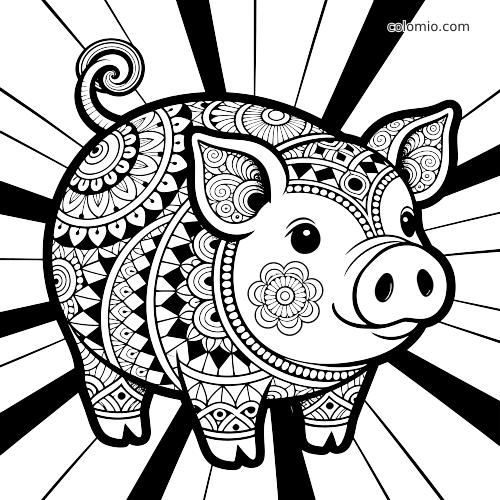
Print our free printable pig coloring pages — ready-to-print line art, no signup.