
What would be a spring motif without tulips? With this step-by-step tutorial, you’ll get a template that will help you draw the beautiful messengers of spring with ease.
For this drawing you need a pencil and good crayons.
Welcome to our fun and easy drawing tutorial, where you will learn how to draw a tulip using simple steps! This guide is perfect for children and beginners who are just starting their artistic journey. With our step-by-step instructions, you’ll gain the skills to create beautiful flower drawings.
This tutorial is designed for kids and beginners aged 5 and up, focusing on basic drawing techniques. You’ll learn how to use pencils and colored pencils to bring your tulip to life. Whether you’re a budding artist or just looking for a creative activity, this guide will help you achieve a natural and vibrant tulip drawing.
What You Will Need
- HB pencil for sketching
- 2B pencil for darker outlines
- Eraser for cleaning up sketches
- Colored pencils in shades of green for leaves and stem
- Red, pink, or yellow colored pencils for the tulip petals
- Quality drawing paper (A4 recommended)

Tip:
Your Tulip Drawing Is Complete!
Congratulations on completing your tulip drawing! You’ve learned how to create a beautiful flower using simple steps, and we hope you had fun along the way. Don’t stop here; explore more of our tutorials to expand your drawing skills.
Check out our other beginner-friendly guides, such as ‘How to Draw a Sunflower’ or ‘How to Sketch a Rose,’ and continue to let your creativity bloom!
Tips for an Even Better Tulip Drawing
Tulips look simple at first glance, but two small details separate a flat, cartoony tulip from one that actually feels like a tulip: the cup shape of the bloom and the graceful curve of the stem. Get those two right and the rest is decoration.
The bloom is essentially three petals seen from the front: one wide center petal and two narrower side petals that overlap behind it. The top of each petal should curve outward, never come to a sharp point. Think of an inverted egg, slightly opened at the top – not a flame.
For the stem, draw a soft S-curve rather than a straight line. Real tulip stems lean slightly under the weight of the flower, and that little tilt is what makes the drawing look natural. The leaves are long, sword-shaped, and almost always asymmetric – one arching up, the other flopping outward.
Tulip Varieties to Try
Once you’ve mastered the basic tulip, experiment with these real-world varieties – each one is just a small modification of the same underlying shape:
- Single Tulip: The classic closed cup. Simple, elegant, beginner-friendly.
- Parrot Tulip: Wavy, ruffled petal edges with bold streaks of two contrasting colors (red and yellow, or pink and white).
- Lily-Flowered Tulip: Pointed, slightly outward-curving petal tips that give the bloom a star shape.
- Double Tulip: Many overlapping petals, almost like a peony. Looks great in groups of three.
- Black Tulip (“Queen of Night”): Deep purple-almost-black petals with a hint of red. Great for practicing rich, dark color layering.
Try drawing the same outline three times, then color each one as a different variety. It’s a quick way to build your color confidence.
Background Ideas to Make Your Tulip Pop
A tulip on its own is beautiful, but a small background turns it into a finished picture. Three quick options:
- Spring meadow: A pale green wash behind the stem with a soft blue sky and one or two distant tulips for depth.
- Single tulip in a glass: Just a simple curved outline of a glass vase with horizontal water line. The stem reflects through the water.
- Dutch row: Repeat your tulip 5–7 times in different colors along a horizontal line. Instantly says “tulip field.”
For Easter or Mother’s Day cards, frame the tulip with a few small dots in a contrasting color – takes seconds and looks deliberate.
Common Mistakes to Avoid
1. The bloom is too wide. A tulip is taller than it is wide. If your flower head looks like a tulip-shaped balloon, slim it down. Petals should rise upward, not bulge sideways.
2. The stem is straight as a ruler. A perfectly vertical stem looks artificial. Even a 5–10 degree S-curve adds life.
3. The leaves are too short. Tulip leaves are nearly as long as the stem and almost always reach above mid-height. Short stubs make the plant look like an artificial flower.
4. The petal seams are missing. Two thin lines inside the bloom – showing where the front petal meets the side petals – instantly add depth. Without them, the bloom reads as a flat blob.
5. Single flat color. A real tulip petal has a darker base near the stem and a lighter glow toward the tip. Even one extra layer of darker color at the bottom transforms a flat tulip into a glowing one.
Frequently Asked Questions About Drawing a Tulip
What is the best pencil grade for sketching a tulip?
An HB pencil is ideal for sketching as it provides a balance between hard and soft, allowing for clear lines that can be easily erased.
Can I use markers instead of colored pencils?
Yes, you can use markers, but be mindful that they may bleed through the paper. Use thicker paper to prevent this.
How do I make my tulip look more realistic?
Focus on layering colors and adding gradients to the petals and leaves. Observing real tulips can also help you understand their structure and colors.
What if I make a mistake while drawing?
Don’t worry! Use an eraser to gently remove any mistakes and redraw the lines. Practicing on scrap paper can also help improve your confidence.
How can I add more depth to my tulip drawing?
Use shading techniques to add depth. Lightly shade one side of the petals and leaves to simulate light and shadow.
Take a picture and send it to [email protected] – we publish it on www.colomio.com!
All tutorials and images are copyrighted by happycolorz GmbH. Interested in using it? Please send a mail to [email protected].
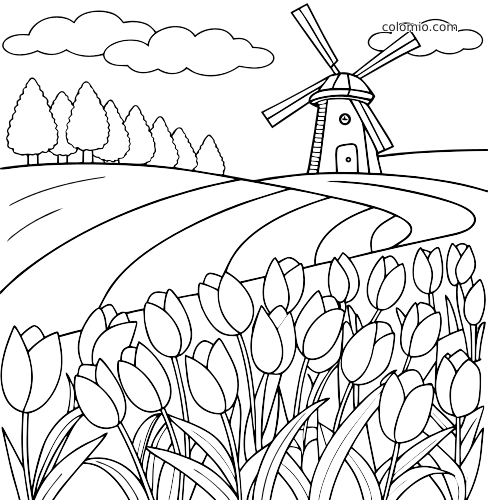
Print our free printable tulip coloring pages — ready-to-print line art, no signup.
More ideas for drawing
-

Airplane drawing -

Plane drawing easy -

Apple drawing -

Bicycle drawing -

Ship drawing -

Car drawing -

Car drawing easy -

Cat drawing -

Cow drawing -

Dinosaur drawing -

Dog drawing -

Puppy drawing -

Dragon drawing -

Digger drawing -

Fairy drawing -

Giraffe drawing -

Lion drawing -

Mermaid drawing -

Moon drawing -

Motorcycle drawing -

Penguin drawing -

Pig zeichnen (einfach) -

Princess drawing -

Reindeer drawing -

Rooster drawing -

Santa Claus drawing -

Shark drawing -

Sheep drawing -

Strawberry drawing -

Sunflower drawing -

Tiger drawing -

Tractor drawing -

Train drawing -

Tree drawing -

Tree drawing easy -

Tulip drawing -

Turtle drawing -

Unicorn drawing -

Unicorn drawing easy -

Witch drawing