


This tutorial will delight all big and small excavator fans. Step by step, you will succeed in drawing a complex technical device.
For the preliminary drawing, you need a hard, easily erasable pencil (e.g. H2 or HB). The best way to draw the final contours is with an eraser-proof pencil.
Welcome to our step-by-step guide on drawing an excavator! This tutorial is perfect for children and beginners who are keen to learn the basics of drawing machinery. With our easy-to-follow instructions, you’ll be crafting a detailed excavator in no time. Whether you’re a young artist or a beginner, this guide will help you develop your drawing skills and ignite your creativity.
In this lesson, we’ll guide you through the process of sketching an excavator using simple geometric shapes and lines. You’ll learn how to break down complex structures into manageable parts, making it easier to create a realistic drawing. By the end of this tutorial, you’ll be able to add intricate details and colors to your excavator, bringing it to life with vibrant hues.
All you need is some basic drawing materials and a bit of patience. So, gather your pencils, erasers, and colored pencils, and let’s embark on this artistic journey together!
What You Will Need
- HB pencil for sketching the basic shapes.
- 2B pencil for adding detailed lines.
- Colored pencils in yellow, blue, and gray for coloring the excavator.
- A good-quality eraser to clean up guidelines.
- A ruler for drawing straight lines.
- A4 drawing paper or sketchpad for a sturdy drawing surface.

Step 1: Frame
To start, grab your HB pencil and draw a large square on your paper. This square will serve as the frame for your excavator. Keep the lines light so you can easily erase them later if needed. Tip: Use a ruler to ensure your square has straight edges.
It’s important to maintain even proportions, as this will help in creating a balanced drawing.

Step 2: Area layout
Next, divide the large square into four different-sized rectangles. These rectangles will help you position the various parts of the excavator. Tip: Visualize how each rectangle will correspond to different sections, like the cab and the undercarriage, for easier construction.
Refer to the template for guidance on the exact sizes and positions of these rectangles.

Step 3: Excavator arm
Now, it’s time to sketch the excavator’s arm. Use your pencil to draw straight lines that outline the boom, spoon handle, and shovel. For accuracy, use a ruler to ensure your lines are straight. Tip: Imagine the arm in sections and draw it in segments for better precision.
This will form the main functional parts of the excavator, so pay attention to their alignment.

Step 4: First details
With the basic structure in place, use your 2B pencil to draw permanent contours. Begin with the undercarriage and crawler track in the lower rectangle. Move on to the middle section to draw the driver’s cab. Tip: Keep your hand steady for clean lines, and don’t rush this step.
Finally, add the boom and dipperstick, ensuring all parts are proportionate and aligned.

Step 5: Bucket, wheels and cab
Enhance your drawing by adding the excavator’s bucket, wheels, and additional details to the cab. Refer to the template to refine these elements and ensure they’re correctly positioned. Tip: Use softer, light strokes initially, then darken them once you’re satisfied with their placement.
This will add more depth and realism to your drawing, making it more recognizable.

Step 6: Windows, hydraulic cylinders & vents
To give your drawing a polished look, add technical details like windows, hydraulic cylinders, and vents. These elements will make your excavator look more professional and complete. Tip: Take your time with these filigree elements to ensure they enhance the overall appearance.
Carefully follow the template instructions to get the positioning just right.

Step 7: Removing the guides
Once you’re happy with your drawing, carefully erase the guidelines. This will make the excavator stand out. Tip: Use a clean eraser to avoid smudging your work.
After removing the guides, you’ll see your hard work pay off in a clear and detailed excavator illustration.

Step 8: Coloring
Now, bring your excavator to life with color! Use yellow for the body, blue for the windows, and various shades of gray for the mechanical parts. Tip: Blend colors smoothly for a more natural look.
Refer to the template for color placement and finish your masterpiece with vibrant hues.
More Template Ideas


Your Excavator Drawing Is Complete!
Congratulations on completing your excavator drawing! You’ve successfully followed each step to create a detailed and colorful illustration. We hope you enjoyed this creative journey and learned new techniques along the way.
If you’re eager to continue honing your drawing skills, check out our other tutorials on drawing different types of machinery and vehicles. Keep practicing, and you’ll soon be an expert in crafting detailed and realistic drawings!
Tips for an Even Better Excavator Drawing
An excavator is essentially three big shapes connected: the tracks at the bottom, the rotating cabin in the middle, and the jointed boom arm with a bucket at the end. Get the proportions of these three right and you can’t go wrong.
The tracks (also called crawlers) should be wider and longer than most beginners draw. They typically span more than half the total length of the machine. Each track is a long oval shape with visible segmented treads – a series of small parallel rectangles running around the edge. Two large drive sprockets (round wheels with teeth) sit at the front and back of each track.
The cabin (also called the house) sits on a circular turntable on top of the tracks. This turntable lets the cabin rotate 360° around. Always show a small gap between the cabin base and the tracks below to make this clear. The cabin itself has a large angled glass front for visibility, with a small chimney-like exhaust pipe rising from the back roof.
The boom arm is the most distinctive feature. It has two visible segments connected by a hinge (the “elbow”): the upper boom (closer to the cabin, usually thicker and curved) and the lower stick (thinner, straight). At the end is the bucket. Multiple hydraulic cylinders are visible – cylindrical pistons that operate the joints – usually one between cabin and boom, one between boom and stick, and one between stick and bucket.
The bucket is a curved scoop with three to five large teeth along the front edge for digging. The teeth point forward and slightly downward when the bucket is in working position.
Excavator Types: Pick Your Style
The same drawing approach adapts to many excavator variations:
- Standard track excavator: The most common type, with two crawler tracks and a single boom arm. Yellow or orange body, like a Caterpillar 320 or Komatsu PC.
- Wheeled excavator: Four large rubber tires instead of tracks – faster on roads, common in European cities. Often has stabilizer arms that fold out for digging.
- Mini excavator: Small, narrow body for tight spaces – a kid-friendly looking machine. Often used in landscaping. Cute proportions.
- Long-reach excavator: Same body as a standard excavator but with an extremely elongated boom arm for reaching across rivers or into deep pits.
- Demolition excavator: Massive size with a very long boom and a different attachment instead of a bucket – usually a hydraulic claw or breaker.
- Bagger 288 (German giant): The world’s largest excavator type – massive bucket wheel on a long arm, multi-story body. Industrial impressive.
- Cartoon construction excavator: Big friendly eyes on the cabin window, oversized bucket like a smiling mouth, bright yellow body. Pure children’s book magic.
What Is the Excavator Doing?
An excavator is most interesting when it’s actually working. Show what it’s digging or moving:
- Scooping up earth: Bucket lowered with a heap of brown soil and stones inside. Add a few small clumps falling out at the edges.
- Lifting a rock: Bucket holding a single large gray boulder, almost too heavy. Add small motion lines for strain.
- Digging a trench: The bucket below ground level inside a clean rectangular trench, with neat piles of dirt on the side.
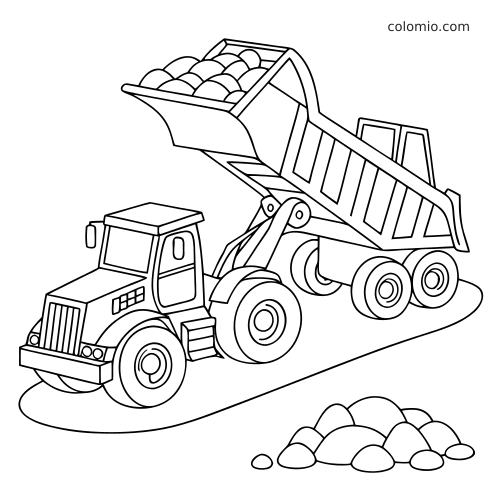
- Loading a truck: Bucket positioned over a dump truck’s open bed, dirt falling into the truck. A classic construction-site duo.
- Demolishing a wall: Bucket smashing through a brick wall, with bricks tumbling and dust clouds rising.
- Idle on the site: Bucket resting on the ground, cabin tilted to the side, the operator visible through the window having a coffee. Quiet moment.
- Lifting a tree: Excavator with a grapple attachment carrying a freshly cut tree trunk. Forestry application.
Construction Site Compositions
- Active construction site: Excavator at the center, dump truck nearby, a worker with a hard hat directing traffic, traffic cones, fenced perimeter.
- Foundation dig: Excavator working in a large rectangular pit, with concrete forms set up nearby for foundations.
- Demolition scene: Half-demolished building in the background, rubble piles, dust clouds, multiple machines working together.
- Road construction: Excavator beside a half-finished road with asphalt being laid, a roller machine in the distance.
- Mine quarry: Massive excavator at the bottom of a stepped quarry, dwarfed by the rocky walls. Sense of scale.
- Children’s construction site: Friendly cartoon excavator with smiling truck and bulldozer friends, blue sky, building blocks for buildings. Storybook style.
- Snowy winter dig: Excavator clearing snow with the bucket, fluffy snow piles, frost on the windows.
Color Palettes for Construction Vehicles
- Caterpillar yellow: Bright sunshine yellow body, black cabin frame, dark gray tracks, silver hydraulic cylinders, red and black logo accents.
- Komatsu yellow-orange: Slightly more orange than Caterpillar, with white “Komatsu” lettering and dark gray tracks.
- Volvo gray: Iconic Volvo construction gray with bright yellow accents, white-and-yellow striped warnings.
- JCB classic: Bright yellow with black accents, distinctive curved cabin shape (especially on wheeled models).
- Storybook bright: Pure cartoon yellow body, big white cabin window, bright red bucket, friendly proportions.
- Heavy-duty rust: Faded yellow body with rust spots, mud splatter on the tracks, oil stains on the boom – well-used and authentic.
Adding Realistic Details
Small touches that elevate any excavator drawing:
- Mud on the tracks: Brown smudges and small clumps stuck to the treads instantly add work-site realism.
- Hydraulic hoses: Black flexible hoses running along the boom arm. Add 3–4 visible ones following the joints.
- Warning lights: Small orange beacon on top of the cabin, with little yellow rays for “flashing.”
- Operator inside: A simple silhouette of a person wearing a hard hat, visible through the cabin glass.
- Brand decals: Block lettering of a brand name on the side of the cabin or boom arm. CAT, Komatsu, Hitachi, Volvo.
- Side mirrors and antennas: Small extensions from the cabin add finishing detail.
- Track wear: Some treads slightly more worn than others – subtle but realistic.
Common Mistakes to Avoid
1. The tracks are too small. Excavator tracks are massive – almost as tall as the cabin. Drawing them as small caterpillar tracks under the body kills the scale.
2. The boom arm has only one segment. A real excavator boom is jointed in the middle. A single straight arm looks like a crane, not an excavator.
3. Forgetting the hydraulic cylinders. The metal pistons between the joints are what makes the excavator look mechanical. Without them, the boom looks like a wooden stick.
4. The bucket faces the wrong way. The bucket teeth always point downward and toward the cabin when the bucket is in working position. Teeth pointing outward means the excavator is dumping.
5. The cabin sits directly on the tracks. There must be a visible turntable disk between the cabin and the tracks – otherwise the cabin can’t rotate.
6. No exhaust pipe. Diesel-powered excavators have a visible exhaust pipe rising from the cabin roof. Without it, the machine looks electric or fake.
7. The tracks point straight ahead. Real tracks taper slightly at the front and back ends, not perfectly rectangular. A flat brick under the cabin looks unrealistic.
Frequently Asked Questions About Drawing an Excavator
What is the best pencil grade to use for the initial sketch?
An HB pencil is recommended for the initial sketching as it provides a good balance between hardness and darkness.
How can I make sure the proportions are correct?
Using a ruler and dividing your initial square into rectangles helps maintain correct proportions for the excavator’s parts.
What should I do if I make a mistake while drawing?
Gently erase the mistake with a good-quality eraser and redraw the section, ensuring your lines are light to avoid smudges.
Can I use markers instead of colored pencils?
Yes, you can use markers, but be cautious as they can bleed through paper. Colored pencils give more control over shading and blending.
How can I improve my drawing skills further?
Practice regularly, observe real excavators, and try drawing different machinery to improve your skills and confidence over time.
Take a picture and send it to [email protected] – we publish it on www.colomio.com!
All tutorials and images are copyrighted by happycolorz GmbH. Interested in using it? Please send a mail to [email protected].
More ideas for drawing
-

Airplane drawing -

Plane drawing easy -

Apple drawing -

Bicycle drawing -

Ship drawing -

Car drawing -

Car drawing easy -

Cat drawing -

Cow drawing -

Dinosaur drawing -

Dog drawing -

Puppy drawing -

Dragon drawing -

Digger drawing -

Fairy drawing -

Giraffe drawing -

Lion drawing -

Mermaid drawing -

Moon drawing -

Motorcycle drawing -

Penguin drawing -

Pig zeichnen (einfach) -

Princess drawing -

Reindeer drawing -

Rooster drawing -

Santa Claus drawing -

Shark drawing -

Sheep drawing -

Strawberry drawing -

Sunflower drawing -

Tiger drawing -

Tractor drawing -

Train drawing -

Tree drawing -

Tree drawing easy -

Tulip drawing -

Turtle drawing -

Unicorn drawing -

Unicorn drawing easy -

Witch drawing
Print our free printable excavator coloring pages — ready-to-print line art, no signup.