

A train with a steam engine is always a nice motif for illustrating children’s stories or invitation cards. Because of its clear and organized shape, a train is quite easy to draw with a good template. This step by step guide can help you create a train with appropriate proportions.
⚠️ This drawing requires care and some patience, because the train will only look really good if everything is drawn neatly and straight. For the drawing you will need a pencil, a ruler, dividers, an eraser, an eraser-proof drawing pencil and good crayons.
Welcome to our exciting tutorial on how to draw a train in just 8 easy steps! Whether you’re a child or a beginner, this guide is perfect for you. Geared towards budding artists aged 5 and up, you’ll learn the basic techniques to create a stunning train drawing.
In this tutorial, we’ll use simple guide lines and basic shapes to help you maintain proportions and create a realistic train. By the end, you’ll have a vibrant and three-dimensional train drawing to be proud of. Let’s get started on this creative journey!
What You Will Need
- A4 drawing paper
- HB pencil for sketching guide lines
- 2B pencil for drawing permanent contours
- Colored pencils in various shades for coloring
- Eraser for removing guide lines
- Ruler for drawing straight lines

Step 1: Division of the drawing area
Let’s start by setting up our drawing area. Use your HB pencil to draw two guide lines on your paper. The first line should mark the lower quarter of your drawing space. Next, divide the remaining area above this line into two equal halves with a second guide line. These lines will help you keep your train in proportion.
Tip: Lightly draw the lines so they can be easily erased later.

Step 2: Wheels
Now, it’s time to draw the wheels of your train. At the back edge of your drawing, use a compass to sketch two large wheels with their centers on the lowest guide line. Then, add two smaller wheels at the front, extending from the bottom edge to the lowest guide line. This will give your train a sturdy foundation.
Tip: Make sure to keep the wheels symmetrical for a balanced look.

Step 3: More guide lines for cab
Next, we’ll add more guide lines to help shape the cab of the locomotive. Draw four vertical guide lines to divide the locomotive into three equal sections. These lines will serve as a framework for your train’s structure.
Tip: Check that your lines are parallel for a neat and tidy appearance.

Step 4: First permanent contours for driver’s cab and boiler
It’s time to outline the locomotive’s cab and boiler. With your 2B pencil, carefully draw the permanent contours of the train, following the guide lines to ensure accuracy. Use a ruler for straight and clear lines, creating a defined shape for your train.
Tip: Take your time with this step to get the proportions just right.

Step 5: vent, tip signal and other details
Now, let’s add some essential details to your train. Sketch features like the chimney, whistle, wheel housings, and rail clearers. These elements will bring your train to life, so pay attention to the guide lines to maintain natural proportions.
Tip: Use light pencil strokes to make adjustments easier.

Step 6: Windows, smoke and boiler rivets
Enhance your train with additional details like windows, rivets, and smoke clouds. These features will add character to your drawing. Use your drawing pencil to trace them neatly, ensuring everything is well-defined.
Tip: Adding different shapes for smoke clouds can make your train appear more dynamic.

Step 7: Removing the guides
With all the details in place, it’s time to clean up your drawing. Carefully use an eraser to remove the underlying pencil guide lines, leaving only the permanent contours of your train. This will give your drawing a polished look.
Tip: Gently brush away eraser shavings to keep your paper clean.

Step 8: Coloring
Finally, bring your train to life with colors! Use colored pencils to fill in your train, employing different shades to create a three-dimensional effect. Adding depth with color will make your train stand out.
Tip: Blend colors softly for smooth transitions and a realistic appearance.
More Template Ideas


Your Train Drawing Is Complete!
Congratulations on completing your train drawing! You’ve successfully used guide lines and basic shapes to create a fantastic piece of art. Keep practicing, and you’ll continue to improve your skills. Why not try our other tutorials, like drawing a car or a plane, to expand your artistic abilities?
Tips for an Even Better Train Drawing
The whole personality of a steam train lives in the front section: the cylindrical boiler, the tall smokestack, and the row of large driving wheels connected by visible piston rods. Get those three right and the rest is just adding cars behind.
The boiler is a long horizontal cylinder, drawn as two stacked horizontal lines with a curved cap at the front. Make it as long as the whole front section of the train – a short boiler looks like a toy. Add a few rivets along the seams (small dots in a regular pattern) for instant detail.
The smokestack is dramatic. It should be tall – about a third the height of the boiler – and have a slightly flared top, like an upside-down funnel. A short, straight stack looks underpowered. From it, billowing puffs of smoke or steam should curl back over the train.
The wheels are the iconic touch. Real steam locomotives have driving wheels that are bigger than the small leading wheels at the very front. Each wheel has visible spokes and a hub, plus a long horizontal connecting rod (called the side rod) linking all the driving wheels together. This rod is what tells the eye “this is a steam train.”
The cabin sits at the back of the locomotive, with a small window and an open doorway where the engineer stands. Add a small bell on top of the boiler in front of the smokestack and a headlamp at the very front.
Train Types: Pick Your Era
The same general drawing approach adapts to dozens of train styles:
- Classic steam locomotive (1880–1950): Tall smokestack, big driving wheels, cowcatcher at the front, pulling tender + freight cars. The most iconic train style.
- Diesel locomotive (1950–present): Sleek rectangular body, no smokestack, smaller wheels, large rectangular windshield. Brightly colored body with company logo.
- High-speed bullet train: Pointed aerodynamic nose, smooth flowing body without rivets, small low wheels, modern white-and-blue color scheme. The Shinkansen look.
- Polar Express style: Big golden steam locomotive, deep red passenger cars, snow on the roof, glowing yellow windows showing children inside. Storybook magical.
- Wooden toy train: Simple geometric shapes – rectangle body, three round wheels, single tall stack with a heart or star puff. Children’s book classic.
- Thomas-style face train: Round face on the front of the boiler with eyes and a smile, bright primary colors, simplified shapes. Pure preschool charm.
- Old Western train: Black locomotive with a giant cowcatcher, “Wells Fargo” or saloon-style lettering on the cars, dusty desert background.
- Subway / metro: Multiple identical car units, large side windows, no separate engine visible, bright fluorescent interior glow.
Build a Full Train
A locomotive alone is fine, but adding cars behind it tells a story:
- Coal tender: The first car behind the locomotive on a steam train. Simple rectangular box with black coal piled on top.
- Passenger coach: Long rectangular car with a row of evenly spaced windows and a small door at each end. Add silhouettes of people inside.
- Freight car (boxcar): A wooden or metal box on wheels, often with a sliding door in the middle. Great for displaying lettering or graffiti.
- Flatbed car: A flat platform with cargo strapped down – logs, cars, or large machinery.
- Tank car: A horizontal cylinder mounted on wheels for carrying liquid (oil, milk). Often white or silver.
- Caboose: The small red car at the very back with a raised cupola for the conductor. Pure American railroad nostalgia.
Connect all the cars with small couplers (a thick horizontal bar between each car). Even three cars gives the train a real sense of length.
Track & Background Compositions
- Tracks in perspective: Two parallel lines that get closer together as they recede into the distance, with horizontal wooden ties (sleepers) between them. The single most important background element.
- Train coming out of a tunnel: Stone arched tunnel entrance, only the front of the train visible, dark mountain above.
- Train on a bridge: Iron trestle bridge over a river or canyon, train silhouetted at the top, mountains in the distance.
- Snowy mountain pass: White snow on the ground and roof, frosted pine trees, smoke puffs steaming dramatically in the cold air.
- Train station: Wooden platform with a roof, passengers waiting with luggage, a clock tower, a stationmaster waving a flag.
- Cornfield prairie: Endless flat horizon, golden cornfields, a single train cutting through. Pure Americana.
- Sunset desert: Train on tracks against a glowing orange-red sky, silhouettes of cacti, long shadows.
Drawing Smoke & Steam
The smoke is half the magic of a steam train. A few tricks:
- Draw smoke as a series of round puffy clouds stacked together, getting larger and more spread out as they trail backward.
- Smoke should always angle backward – never straight up – to suggest forward motion.
- Use two shades of gray: lighter on the top of each puff, darker underneath, for a 3D effect.
- Add a few sparks (tiny orange dots) within the first puffs near the smokestack for steam-engine realism.
- For cold-weather scenes, draw the smoke as brighter white against a darker sky for maximum contrast.
Color Palettes for Trains
- Classic steam: Glossy black boiler with brass fittings (gold), red wheels, dark green or blue passenger cars, brown wooden trim.
- Polar Express: Deep gold boiler, deep crimson passenger cars, white snow accents, glowing warm yellow windows.
- Modern bullet train: Pure white body with electric blue stripes, dark gray wheels, silver windows.
- Storybook toy: Bright primary colors – red engine, yellow tender, blue passenger car – with white pop highlights.
- Vintage western: All-black locomotive, dusty brown freight cars, faded red caboose, sepia-toned background.
Common Mistakes to Avoid
1. The smokestack is too short. A short stack makes a steam train look stubby. It should be visibly tall and slightly flared at the top.
2. All wheels are the same size. Real steam trains have small leading wheels and big driving wheels. Drawing all wheels equal makes the train look like a toy car.
3. Forgetting the side rod. The horizontal bar connecting the driving wheels is what makes the train read as a steam locomotive. Without it, it looks like a giant tank.
4. The boiler is a perfect rectangle. The boiler is a cylinder, with a curved front cap. A flat rectangular body looks like a shipping container on wheels.
5. Smoke goes straight up. Smoke from a moving train always trails backward. Vertical smoke makes the train look stationary.
6. The tracks are parallel without perspective. If the train is shown on tracks going into the distance, the rails must converge. Otherwise the perspective is broken.
7. No headlamp at the front. A small round headlamp on the front of the boiler is essential – without it, the train looks unfinished.
Frequently Asked Questions About Drawing a Train
What type of paper is best for drawing a train?
A4 drawing paper is recommended as it provides a smooth surface and ample space for your train drawing.
How can I ensure my train drawing is proportionate?
Using guide lines is crucial for maintaining proportions. They serve as a framework to align your drawing accurately.
What should I do if I make a mistake?
If you make a mistake, gently erase it with an eraser and redraw the section. Light pencil strokes help with easy corrections.
How can I add depth to my train drawing?
Using different shades of colored pencils helps create a three-dimensional effect, adding depth and realism to your drawing.
What is the best way to draw straight lines for the train?
Use a ruler to draw clear and straight lines, ensuring that your train’s contours are well-defined and precise.
Take a picture and send it to [email protected] – we publish it on www.colomio.com!
All tutorials and images are copyrighted by happycolorz GmbH. Interested in using it? Please send a mail to [email protected].
More ideas for drawing
-

Airplane drawing -

Plane drawing easy -

Apple drawing -

Bicycle drawing -

Ship drawing -

Car drawing -

Car drawing easy -

Cat drawing -

Cow drawing -

Dinosaur drawing -

Dog drawing -

Puppy drawing -

Dragon drawing -

Digger drawing -

Fairy drawing -

Giraffe drawing -

Lion drawing -

Mermaid drawing -

Moon drawing -

Motorcycle drawing -

Penguin drawing -

Pig zeichnen (einfach) -

Princess drawing -

Reindeer drawing -

Rooster drawing -

Santa Claus drawing -

Shark drawing -

Sheep drawing -

Strawberry drawing -

Sunflower drawing -

Tiger drawing -

Tractor drawing -

Train drawing -

Tree drawing -

Tree drawing easy -

Tulip drawing -

Turtle drawing -

Unicorn drawing -

Unicorn drawing easy -

Witch drawing
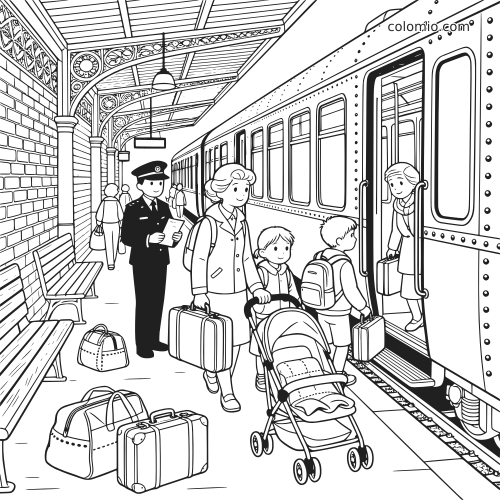
Print our free printable train coloring pages — ready-to-print line art, no signup.