
EasyAdvanced
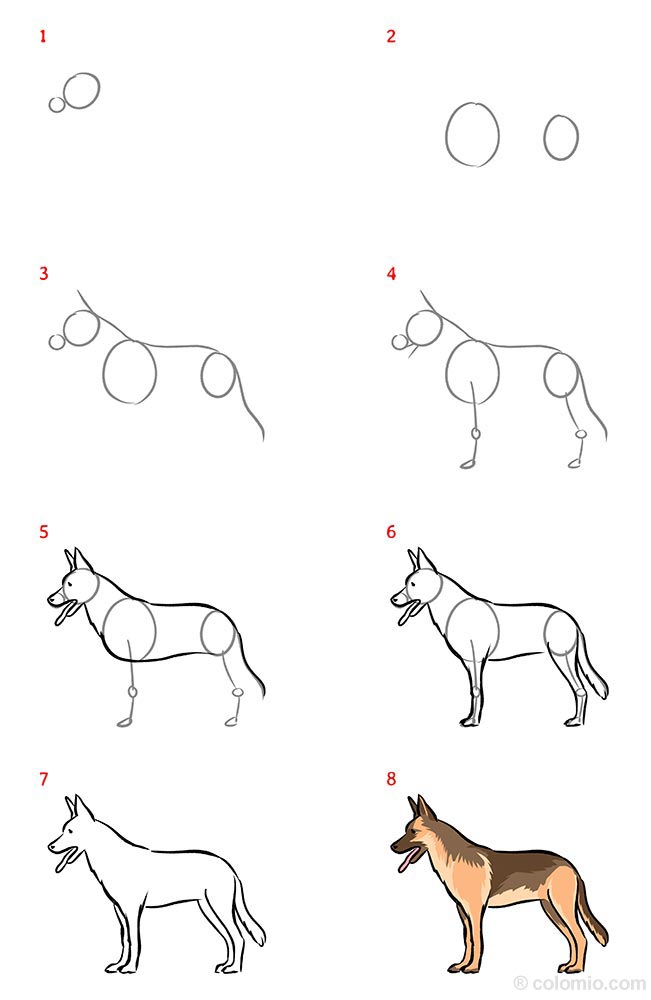
In this tutorial, we’ll guide you through the process of drawing an adorable dog, perfect for young artists and beginners aiming to improve their skills. You’ll learn to capture the playful essence of a dog, right from its perky ears to its wagging tail.
We’ll be using a framework based on simple shapes like circles, ovals, and rectangles to form the dog’s body. This method will help you understand the dog’s anatomy and ensure your drawing looks balanced and proportionate.
What You Will Need
- A sheet of drawing paper
- HB pencil for light sketching
- 2B pencil for darker outlines
- Colored pencils in brown, black, and white for realistic coloring
- A good quality eraser
Begin by using your HB pencil to sketch the initial guide lines. These should be light so that they can be easily erased later. Once you’re satisfied with the overall shape, use the 2B pencil for defining the permanent contours.

Step 1: Head and muzzle
Start by drawing a large circle slightly off-center on your paper. This will be the main part of the dog’s head. Below this circle, draw a smaller oval that overlaps the bottom of the circle to form the muzzle.
The circle should be large enough to accommodate the dog’s facial features, while the oval should be proportionate to the circle, indicating the snout. Ensure the oval overlaps about a third of the circle’s bottom.
Tip: Keep your lines light and sketchy at this stage. You can refine them later as you build up the details.

Step 2: Hull
Next, create the dog’s body by drawing an elongated oval shape that connects to the head. Position this oval slightly to the right of the head to suggest the dog’s sitting posture.
This oval should be about twice the length of the head to give room for the torso and hindquarters. The positioning should give a sense of natural canine posture, with the body slightly angled from the head.
Important detail: Ensure the body oval is horizontally aligned to suggest stability and balance.

Step 3: Ears, neck, back & tail
For the ears, draw two triangles on top of the head circle. Then, sketch the neck connecting the head and the body. Extend a line from the back of the head to form the back and then slightly curve it downwards towards the tail.
The ears can be upright or floppy, depending on the breed you’re depicting. The neck should be thick enough to support the head, and the back should flow smoothly into the tail, which can be a simple curved line.
Tip: Adjust the ear style to match different breeds – pointed for a German Shepherd, floppy for a Labrador.

Step 4: Limbs
Draw the front legs by sketching two parallel lines extending downwards from the body’s front. Add two more lines for the hind legs slightly bent at the knees to suggest a sitting position.
The legs should be of equal length and proportionate to the body size. Ensure the hind legs have a slight bend to give the impression of a relaxed, seated dog.
Important detail: Remember to add small ovals at the end of each leg to form the paws.

Step 5: Permanent contours for ears and face
Use the 2B pencil to trace over the ears and face, adding details like the eyes, nose, and mouth. Begin by placing the eyes at the mid-point of the head circle, equidistant from each other.
The eyes should be slightly tilted to give a friendly and alert expression. Position the nose at the end of the muzzle oval, and sketch a gentle smile for a friendly demeanor.
Tip: Add a small dot in each eye to represent the pupils, giving life to your dog’s facial expression.

Step 6: Finished silhouette
Using firm, confident strokes, outline the entire silhouette of the dog with the 2B pencil. Ensure all body parts are well connected and proportionate.
This stage is crucial to finalize the form of the dog. Check for any inconsistencies or disproportionate parts and adjust them before proceeding.
Important detail: Make sure the silhouette captures the essence of the dog breed you aim to portray.

Step 7: Removing the guides
Carefully erase all the guide lines used to construct the dog’s shape, leaving only the permanent contours.
Use a clean eraser to avoid smudging, and ensure all unnecessary lines are removed for a clean finish. This will prepare your drawing for the coloring phase.
Tip: Brush off eraser shavings gently to avoid smudging your drawing.

Step 8: Coloring
Now it’s time to bring your dog to life with color! Use the brown colored pencil to shade the dog’s body, varying pressure to add depth.
For a realistic touch, use the black colored pencil to darken areas like the nose, the tips of the ears, and the outline of the eyes. Add highlights with the white colored pencil around the muzzle and chest area.
Important detail: Leave small areas around the eyes and nose uncolored to simulate light reflection, enhancing the three-dimensional effect. Blend the colors smoothly for a natural fur effect.
Optional Enhancements to Try
- Add a simple background with green grass to suggest a playful outdoor setting.
- Draw a ball or bone beside the dog to add a playful element.
- Incorporate a collar with a name tag for a personalized touch.
- Add a shadow beneath the dog using light gray to give it a grounded look.
More Template Ideas


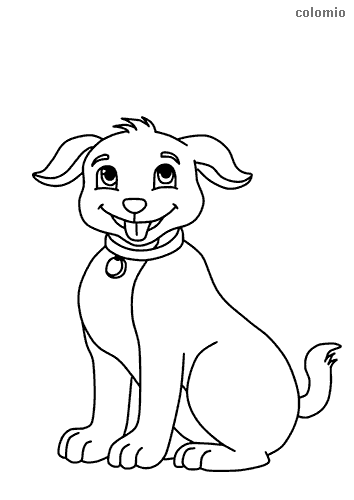
Simple dog paint (for children)
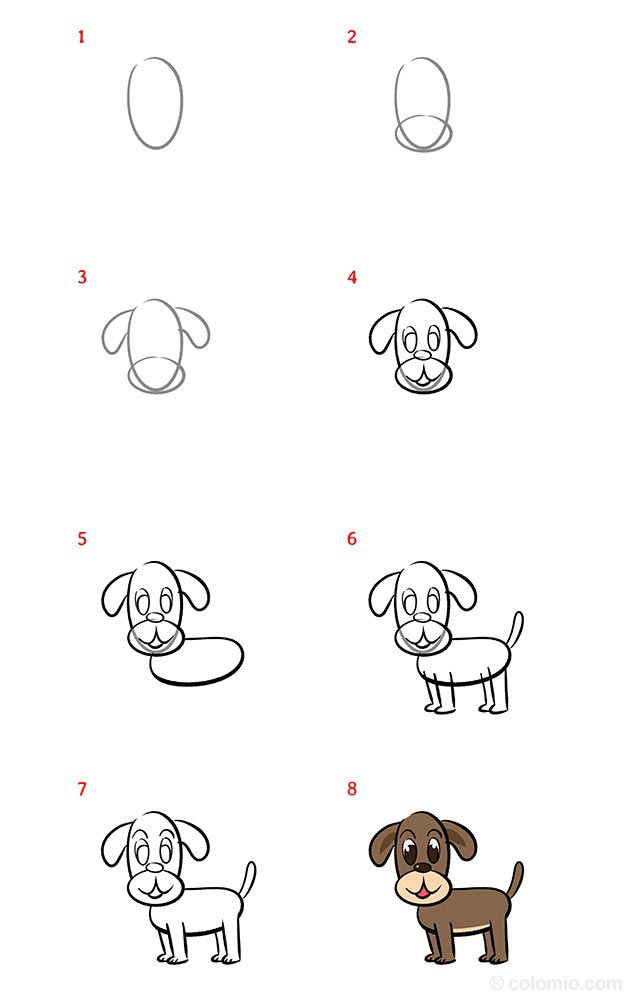
Today, we’re going to draw a delightful dog, perfect for young artists and beginners. This tutorial is designed specifically for kids who are eager to learn how to transform simple shapes into a charming canine companion.

Step 1: Head
Draw a large circle in the middle of your paper. This circle will form the base of the dog’s head. Make sure it’s not too big, leaving room for the rest of the body.
This initial circle helps establish the size and position of the dog’s head. By starting with a simple shape, you can more easily adjust the size or shape before adding details.
Tip: Use light strokes so that you can easily erase and modify the shape if needed.

Step 2: Muzzle
From the bottom of the head circle, draw an oval extending downward. This will be the muzzle of your dog.
The oval shape helps in creating a base for the mouth and nose, ensuring they are proportionate to the head. This step is crucial for capturing the dog’s facial characteristics.
Tip: Keep the oval slightly smaller than the head to maintain a balanced look.

Step 3: Ears
Add two floppy oval shapes on either side of the top of the circle. These will become the dog’s ears.
Positioning the ears at the top of the head gives the dog a friendly, approachable appearance. Adjust the angle of the ovals to make the ears look natural.
Tip: Experiment with different ear shapes and sizes to create different dog breeds!

Step 4: Permanent contours for the head
Using your soft pencil, trace over your light sketches to define the contours of the dog’s head and face.
This is where you add definition to your drawing. Emphasize the lines you want to keep and gently erase the unnecessary guide lines, refining the shape of the head and muzzle.
Important detail: Pay attention to symmetry as you finalize the contours for a realistic look.

Step 5: Hull
Draw an oval underneath the head for the dog’s body, slightly larger than the head circle.
This shape will form the main structure of the dog’s torso. Align it centrally with the head to give your dog a balanced body.
Tip: Keep the body oval slightly tilted to add a dynamic posture.

Step 6: Tail and legs
Use small rectangles to outline the legs and a curved line for the tail, extending from the body oval.
These simple shapes will guide you in drawing the legs and tail, ensuring they are proportionate to the body.
Tip: The tail can be curved or straight, depending on the breed you’re drawing.

Step 7: Removing the guides
Carefully erase all the light guide lines, leaving only the permanent contours of your dog visible.
This step cleans up your drawing, preparing it for coloring. Make sure the main outlines are clear and bold.
Important detail: Double-check that all necessary features are defined before moving on to coloring.

Step 8: Coloring
Begin coloring your dog with brown for the body, using black for the nose and eyes. Add white to highlight and add depth.
Create a realistic texture by varying the pressure of your colored pencils. Use lighter strokes for highlights and darker strokes for shadows.
Important detail: Leave small white areas in the eyes to mimic light reflection, enhancing the lifelike quality of your drawing.
Optional Enhancements to Try
- Add a collar with a name tag for personality.
- Draw a background like a park or backyard for context.
- Include a shadow beneath your dog to give depth.
- Add a ball or toy in front of the dog for a playful touch.
Your Dog Drawing Is Complete!
Congratulations on completing your dog drawing! You’ve learned how to construct a dog using simple shapes, refining your ability to capture proportion and features.
Now that you’ve mastered this technique, why not try other tutorials on drawing different animals or even landscapes? Keep practicing to enhance your skills and creativity!
Dog Breeds: Beyond the Standard Mutt
The same body plan adapts to dozens of dog breeds with just silhouette and detail changes:
- Labrador Retriever: Medium-large body, broad head, friendly muzzle, floppy ears, otter-like tail. Black, yellow, or chocolate coat. The most beloved family dog.
- Golden Retriever: Similar size to Lab but with longer, wavy golden fur, soft feathering on the legs and tail, friendly “smile.” Always cheerful.
- German Shepherd: Tall and athletic with pointed upright ears, long muzzle, alert posture, sloped back, bushy tail. Tan-and-black saddle pattern.
- French Bulldog: Compact body, oversized bat-like upright ears, flat smushed face, big round eyes, short stubby tail. Internet-darling charm.
- Dachshund: Extremely long body, very short legs, long pointed snout, floppy ears. Often drawn in profile. Hot-dog silhouette.
- Pug: Small chubby body, smushed wrinkly face, big round eyes, curly tail, fawn-and-black coloring. Always a bit grumpy and a bit cute.
- Border Collie: Medium athletic body, intense intelligent stare, long fluffy fur, classic black-and-white markings. Often shown herding sheep.
- Husky: Wolf-like build, thick double coat, distinctive face mask, often piercing blue eyes, curled fluffy tail. Snowy-mountain energy.
- Poodle: Distinctive curly fur, often clipped in show patterns (pompoms on legs and tail), elegant proud posture. Show-dog refinement.
- Chihuahua: Tiny body, oversized head and eyes, large bat ears, slim legs. Often drawn in a purse or sweater. Sass on four legs.
- Beagle: Medium body, long droopy ears, broad muzzle, classic tri-color (black, white, tan). Always sniffing.
- Saint Bernard: Massive body, huge fluffy tail, drooping jowls, gentle face, brown-and-white coat. Often drawn with a small barrel around the neck.
- Dalmatian: Athletic body, white coat with random black spots covering everything (no symmetric pattern), floppy ears. Firehouse classic.
- Corgi: Long low body, very short legs, large upright ears, no tail (or a short stubby one), fluffy bottom. Royal favorite.
- Puppy: Smaller body with proportionally bigger head, oversized paws, big innocent eyes, slightly clumsy posture. Universal cuteness.
- Cartoon dog: Round friendly face, oversized smile, wagging tail with motion lines, big sparkling eyes. Pure children’s book joy.
Pose Variations: Bring Your Dog to Life
Dogs are some of the most expressive animals in art. Try these poses:
- Sitting attentive: Back legs folded, front legs straight, head up, ears alert, tail curled around. The classic obedient pose.
- Lying down with paws crossed: Body relaxed on the floor, head up, front paws crossed elegantly. Dignified.
- Sleeping curled up: Body in a tight circle, nose tucked under the tail. Pure peace.
- Mid-run: All four legs extended, body stretched horizontally, tongue lolling out, ears flying back. Joy in motion.
- Play bow: Front legs flat on the ground, back end up high, tail wagging, big grin. The universal dog “let’s play” signal.
- Begging on hind legs: Sitting upright on the rear with front paws raised in front. Pleading expression.
- Catching a frisbee: Mid-jump with body extended, mouth open to grab a flying disc. Action-packed.
- Howling at the moon: Head tilted upward, mouth open, body slightly stretched. Wolfish and atmospheric.
- Tilted head listening: Sitting with head cocked to one side, ears perked, the universal “what did you say?” pose.
- Chasing tail: Body curved in a circle as the dog spins after its own tail. Comic and dynamic.
- Splashing in water: Dog mid-jump into water with droplets flying everywhere. Pure joy.
- With a stick: Tail high, stick in mouth, eyes locked on the human. The classic fetch pose.
Scene Compositions for Dogs
- Dog with bone: Dog lying with a large bone between the front paws, eyes guarding it. Possessive and cute.
- Dog at the door: Dog sitting by the door with a leash in its mouth, ready for a walk. Universal dog-owner moment.
- Dog with a child: Big dog and small kid sitting together, dog offering a paw or licking the kid’s face. Heartwarming.
- Dog at the beach: Wet fur, sandy paws, ball in mouth, ocean in the background. Pure summer joy.
- Dog by the fireplace: Curled up on a rug in front of a warm fireplace, eyes closed. Cozy winter mood.
- Dog in the snow: Snowy paw prints, snowflakes falling, dog mid-jump catching one. Magical winter.
- Multiple dogs at the park: Various breeds playing together, leashes hanging, owners chatting. Park scene.
- Dog with newspaper: Sitting up holding a rolled newspaper in its mouth. Classic morning routine.
- Dog in a costume: Halloween or Christmas outfit, slightly embarrassed expression. Internet-perfect.
- Mother dog with puppies: Adult dog lying on her side with 3–5 puppies nursing or sleeping against her belly. Tender.
- Dog and cat together: Unlikely friends curled up sleeping together. Sweet contradiction.
- Dog on a hike: Dog with a small backpack on a forest trail, nose to the ground. Adventure mode.
Color Palettes for Different Dogs
- Classic Golden Retriever: Warm golden body with cream highlights, dark brown eyes, black nose, pink tongue, bright friendly smile.
- Black Lab elegance: Pure glossy black fur with subtle blue undertones, brown eyes, pink tongue, jet-black nose. Sleek and noble.
- German Shepherd saddle: Tan body with a black saddle-shaped marking on the back, dark muzzle, bright amber eyes.
- Husky striking: Grey-and-white double coat, black face mask, vivid ice-blue eyes, pink tongue. Wolf-like beauty.
- Pug fawn-and-black: Pale fawn body, black mask covering the muzzle, dark wrinkles, big shiny eyes.
- Dalmatian classic: Pure white coat with random black spots (no symmetry – the more random, the better), floppy black-tipped ears.
- Storybook puppy: Soft cream body, pink belly, oversized round eyes with sparkles, pastel collar with bell. Pure children’s book gold.
- Tri-color beagle: White base with bold black saddle and tan accents on the face, ears, and legs.
- Vintage sepia portrait: Muted brown tones, soft grain, classical pose. Old family photo feel.
- Bright cartoon: Pure cartoon brown body, oversized white belly patch, pink tongue, big black nose, friendly proportions.
Mastering Dog Expressions
The whole personality of a dog drawing lives in the face. Small details signal big emotions:
- Happy dog: Tongue out, mouth open in a smile, eyes squinted slightly, ears relaxed. Tail high (visible motion if shown).
- Curious dog: Head tilted to one side, ears perked forward, mouth closed, eyebrows raised slightly.
- Sad dog: Eyebrows drawn upward in the middle, lower eyelids slightly droopy, mouth small and closed. The infamous puppy-dog eyes.
- Alert dog: Body upright, ears straight up, eyes wide and focused forward, mouth closed.
- Scared dog: Tail tucked between the legs, ears flat against the head, body crouched low, eyes wide with whites showing.
- Aggressive dog: Lips pulled back showing teeth, ears pinned back, hackles (fur on the back) raised, body tense.
- Sleepy dog: Half-closed eyes, mouth slightly open, head dropped low. Relaxed muscles throughout.
- Begging dog: Eyes wide and pleading, head slightly tilted, mouth slightly open showing pink tongue. The classic “please feed me” look.
Common Mistakes to Avoid
1. The legs are too straight. Real dog legs have a slight bend at the elbow (front) and the hock (back). Perfectly straight legs look stiff.
2. The tail is too thick or too thin. Match the tail thickness to the body and breed. A whip-thin tail looks unnatural on a sturdy Labrador.
3. The mouth is centered like a cat’s. Dog mouths sit further forward on the snout, with the lips visibly hanging slightly below the muzzle line.
4. Ears in the wrong position. Each breed has signature ear placement – pointed up for German Shepherds, floppy down for Beagles, bat-like sideways for Frenchies. Get the breed’s ears right.
5. Symmetric perfect dog. Real dogs are slightly asymmetric – one ear flopped, head tilted, tongue out one side. Force-fitting symmetry kills the personality.
6. Forgetting the eyebrows. Two small marks above each eye, even subtle, instantly add expression. Without them, the dog looks blank.
7. The nose is too small. Dog noses are prominent. A tiny dot looks like a button, not a sniffing organ.
8. The collar is missing. A small collar (and optional tag) instantly tells the eye “this is a pet, not a wild canine.” Optional but powerful detail.
Frequently Asked Questions About Drawing a Dog
How do I make my dog’s fur look realistic?
Use light, quick strokes with your colored pencils to mimic the texture of fur. Layer different shades of brown and black for depth and variation.
What should I do if my dog’s proportions look off?
Double-check the size of each shape relative to the others. Use your HB pencil to lightly adjust and re-sketch areas until they look balanced.
How can I draw different dog breeds using this tutorial?
Adjust features such as the ears, muzzle length, and tail shape to reflect different breeds. For example, use long, floppy ears for a Cocker Spaniel or a bushy tail for a Husky.
Why doesn’t my dog’s face look expressive?
Pay attention to the eyes and mouth. Slight adjustments in their angles and curves can significantly change the expression. Adding highlights in the eyes can also make them appear more lively.
How do I prevent smudging while drawing?
Keep a piece of scrap paper under your drawing hand to avoid smudging the pencil marks. Also, work from top to bottom if you’re right-handed, and vice versa if you’re left-handed.
What colors can I use for a more accurate representation of my dog?
Observe the specific colors of your dog’s coat and use similar shades. You might need to blend multiple colors to achieve the exact hue, especially for mixed breeds.
Take a picture and send it to [email protected] – we publish it on www.colomio.com!
All tutorials and images are copyrighted by happycolorz GmbH. Interested in using it? Please send a mail to [email protected].
More ideas for drawing
-

Airplane drawing -

Plane drawing easy -

Apple drawing -

Bicycle drawing -

Ship drawing -

Car drawing -

Car drawing easy -

Cat drawing -

Cow drawing -

Dinosaur drawing -

Dog drawing -

Puppy drawing -

Dragon drawing -

Digger drawing -

Fairy drawing -

Giraffe drawing -

Lion drawing -

Mermaid drawing -

Moon drawing -

Motorcycle drawing -

Penguin drawing -

Pig zeichnen (einfach) -

Princess drawing -

Reindeer drawing -

Rooster drawing -

Santa Claus drawing -

Shark drawing -

Sheep drawing -

Strawberry drawing -

Sunflower drawing -

Tiger drawing -

Tractor drawing -

Train drawing -

Tree drawing -

Tree drawing easy -

Tulip drawing -

Turtle drawing -

Unicorn drawing -

Unicorn drawing easy -

Witch drawing
Print our free printable dog coloring pages — ready-to-print line art, no signup.