

EasyAdvanced
Today, we’re going to learn how to draw a magnificent tree, perfect for young artists and beginners who want to explore the wonders of nature through art. This tutorial is designed for children and novice artists who are eager to enhance their skills by capturing the beauty and complexity of trees.
We’ll be using a structured approach based on a simple silhouette of the trunk and branches. This technique allows us to focus on the basic shapes and proportions before adding detailed elements like leaves and spatial effects that bring the tree to life.
What You Will Need
- A sketchbook or drawing paper
- HB pencil for initial outlines
- 2B pencil for darker lines and details
- Colored pencils in shades of green, brown, and gray
- An eraser for refining your drawing
Begin with your HB pencil to sketch the initial outlines lightly. As you progress, use the 2B pencil to darken and define the tree’s details. Finally, bring your creation to life with colored pencils, adding depth and texture to your drawing.

Step 1: Silhouette of the trunk and outer branches
Start by sketching a simple silhouette of the tree trunk in the center of your paper. Extend this shape upwards into a series of broad, slightly curved lines to represent the outer branches.
The trunk should be thicker at the base, gradually thinning as it reaches the branches. These lines serve as the foundation, setting the size and form of your tree. Think of them as the ‘skeleton’ of your tree drawing.
Tip: Keep your lines gentle and fluid to mimic the natural flow of a tree’s growth.

Step 2: The branch forks
Next, draw the forked branches extending from the main branches. Start by creating Y-shaped splits where these branches diverge.
Each branch should split into at least two smaller branches, which will help your tree look more realistic and complex. This branching pattern is crucial for simulating the natural growth of trees.
Important detail: Ensure the forks are uneven and varied in direction for a more natural appearance.

Step 3: Finishing the main branches
Now, complete the main branches by adding more lines to define their form and thickness. These lines should follow the initial guides but with more detail and precision.
Consider the light source by shading the underside of each branch slightly to create depth and dimension. The branches should taper gradually as they extend outward from the trunk.
Tip: Use your 2B pencil here to add darker lines and shading for a more pronounced effect.

Step 4: More small branches & leaf crown
Fill in the smaller branches and begin sketching the leaf crown. Use a series of short, curved lines to form clusters of leaves at the tips of the branches.
These clusters should vary in size and shape to mimic the irregularity found in nature. The leaf crown is the lush canopy that gives your tree its full, vibrant appearance.
Important detail: Overlapping some leaf clusters will give your tree a more three-dimensional feel.

Step 5: Spatial effects
To add spatial effects, incorporate details like bark texture and shadows. Lightly sketch vertical lines along the trunk to simulate bark.
Add shadows beneath the branches and leaves to give the tree a grounded appearance. Consider the direction of light when placing these shadows to enhance the realism.
Tip: A few well-placed shadows can significantly enhance the depth and volume of your tree drawing.

Step 6: Coloring
Finally, it’s time to color your tree. Use a variety of green shades for the leaves, starting with a base color and layering darker and lighter greens for contrast.
Color the trunk and branches with browns, using darker tones to highlight the shadows and lighter tones for the sunlit areas. Finish by adding hints of gray to enhance the texture of the bark.
Important detail: Leave small areas of the leaf crown uncolored to represent light filtering through the leaves, adding a realistic shimmer to your tree.
Optional Enhancements to Try
- Add a shadow beneath the tree using light gray to give it a grounded look.
- Include a few birds or a squirrel to bring life to your tree.
- Draw some grass and flowers around the base to create a natural setting.
- Sketch a background with a distant forest to give your tree a place in a lush landscape.
Draw simple tree
Today, we’ll embark on an exciting journey to draw a beautiful tree, perfect for young budding artists and beginners. Trees are a wonderful subject because they offer a combination of easy shapes and lots of room for creativity.

Step 1: Silhouette of the trunk and outer branches
Begin by drawing a vertical rectangle for the tree trunk in the center of your paper. This will act as the main support of your tree. Extend a few lines from the top of the rectangle to create the basic silhouette of the outer branches.
These lines don’t have to be perfectly straight; in fact, slightly curved lines will give your tree a more natural look. The trunk should be wider at the bottom and taper slightly towards the top.
Tip: Keep your lines light so they can be easily adjusted if needed.

Step 2: The branch forks
Next, let’s add some forks to the branches. Draw Y-shaped lines on each of the main branches you’ve sketched. These will represent the points where branches split off into smaller ones.
These Y-shaped forks are essential as they give your tree its unique structure. By varying the angles and lengths of these forks, you can create a more interesting and realistic tree shape.
Important detail: Trees have many branches, so feel free to add as many forks as you like for a fuller look.

Step 3: Crown
Draw circles and ovals around the outer branch areas to form the tree’s crown. These shapes will represent the dense clusters of leaves.
You can overlap some of these circles to create a more natural and rounded appearance for the tree’s foliage. Remember, tree crowns are not perfectly symmetrical, so it’s okay to have a few irregularities.
Tip: Make some circles larger than others to show depth and dimension.

Step 4: Spatial effects
To add spatial effects, draw smaller branches and twigs within the crown, extending from the main branches. This will give your tree more depth and complexity.
These smaller branches should be drawn with a lighter touch to create a sense of perspective, making them appear as though they are further back in space.
Important detail: Use lighter strokes for distant branches to enhance the depth effect.

Step 5: Fruits
Now, let’s make our tree even more lively by adding fruits. Draw small circles on random branches to depict fruits like apples or oranges.
These fruits can be scattered throughout the tree, but make sure to place them in areas where they look naturally supported by the branches.
Tip: Vary the size and position of the fruits to make them look more natural.

Step 6: Coloring
Now, it’s time to bring your tree to life with color! Use a green colored pencil to fill in the crown, creating a lush appearance.
Apply a brown pencil to the trunk and branches, pressing harder in some areas to show shadows and texture. Finally, use a red pencil for the fruits, adding a touch of realism.
Important detail: Leave small areas of white on the fruits to simulate light reflections, making them appear shiny and three-dimensional.
Optional Enhancements to Try
- Add a shadow beneath the tree using light gray to give it a grounded look.
- Draw birds or insects resting on the branches for added life.
- Include flowers at the base of the tree for a springtime feel.
- Sketch a background landscape to place your tree in a natural setting.
Your Tree Drawing Is Complete!
Congratulations on completing your tree drawing! You’ve learned how to use simple shapes to build a complex and beautiful structure. This technique will serve you well in many future drawing endeavors.
We encourage you to explore other tutorials on our site. Each one offers new techniques and subjects to expand your artistic skills. Happy drawing!
Easy Tree Drawing — The Three-Minute Version
If the full 6-step tutorial feels too detailed, here is the easy tree drawing express path: draw a thick vertical line for the trunk, two main branches forking left and right at the top, and a single round or fluffy cloud shape on top to suggest the leafy crown. That is it. The whole drawing takes under three minutes and works as a great first simple tree drawing for beginners. Use a pencil for the trunk and a green marker for the crown — instant tree.
Pine Tree Drawing — The Triangular Evergreen
A pine tree drawing uses a completely different shape from a leafy tree. Start with a tall, narrow triangle. Then draw smaller overlapping triangles from top to bottom, each slightly wider than the one above, like a layered Christmas tree. Add a thin trunk peeking out at the bottom. Variations include the lone mountain pine (single tall narrow tree), the dense Christmas-tree style (wide and bushy), or a forest of pines with overlapping silhouettes. Color with dark green and a touch of brown at the trunk.
Oak Tree Drawing — The Mighty Spreading Branches
An oak tree drawing emphasizes the strength of its trunk and the wide reach of its branches. Draw a thick, slightly tilted trunk (oaks are rarely perfectly straight), then two or three big branches splitting outward almost horizontally — oaks spread wide, not tall. Add irregular leaf clumps along the branches, leaving some bare wood visible. The bark on an oak is rough and cracked — use short horizontal lines to suggest texture. A classic English oak silhouette is wider than it is tall.
Realistic Tree Drawing — Add Texture and Volume
To turn your sketch into a realistic tree drawing, focus on three things: bark texture (short vertical lines on the trunk with deeper grooves), leaf clumps (small ovals layered on top of each other, not a single round blob), and a clear light source with shadows on the opposite side of the trunk and beneath the canopy. Add a few fallen leaves or a small shadow on the ground at the base — this anchors the tree to the scene and makes it feel three-dimensional.
Tree Drawing for Kids
A tree drawing for kids needs to be unfussy: one thick brown trunk, one big round green crown, and (optionally) one red apple, three green leaves, or a tire swing for fun. Crayon-friendly thick outlines. Most kids prefer drawing several trees in a row to make a small forest — encourage that. The classic “round lollipop tree” is iconic for a reason: it works.
Tree Species: Beyond the Standard Round Tree
The same drawing approach adapts to almost every real tree species, with just a handful of changes to the silhouette:
- Oak: Wide, round, full canopy with strong horizontal branches. Thick gnarled trunk with deep bark texture. The classic storybook tree. Adds gravitas to any landscape.
- Pine / Fir: Tall triangular silhouette, short horizontal branches getting smaller toward the top, dark green needles instead of leaves. Snow rests on each branch beautifully in winter scenes.
- Willow (weeping): Tall slim trunk with branches cascading downward like green hair. Dramatic and romantic, perfect for ponds.
- Birch: Slim, tall trunk with iconic white bark and short black horizontal stripes. Often drawn in clusters of 3–5. Very Scandinavian.
- Palm: Tall slim curving trunk topped with a fan of long radial fronds. Tropical postcard classic. Bonus: hanging coconuts.
- Maple: Round canopy with the iconic 5-pointed leaf shape visible in the silhouette. Perfect for autumn red-orange-yellow color schemes.
- Cherry blossom (sakura): Spreading horizontal canopy with bright pink puffy flower clusters instead of leaves. Spring magic.
- Apple tree: Round canopy with bright red apples scattered throughout the green leaves. Add fallen apples below.
- Christmas tree: Triangular pine shape with colorful round ornaments, tinsel, and a star or angel on top. Holiday card classic.
- Bonsai: A tiny stylized tree in a shallow pot, with carefully shaped sweeping branches. Japanese aesthetic.
- Baobab: Massive bottle-shaped trunk with sparse branches at the top spreading like upside-down roots. African savanna icon.
- Dead/bare tree: Bare twisted branches without leaves, gnarled trunk. Perfect for Halloween, winter, or moody landscapes.
Drawing the Four Seasons of a Tree
The same tree silhouette can show all four seasons with just color and texture changes:
- Spring: Pale fresh green leaves, small pink or white blossoms, blue sky, soft lighting. New beginnings.
- Summer: Deep saturated green canopy, full and lush, dappled shadow patterns underneath, golden sunlight.
- Autumn: Mix of orange, red, yellow, and brown leaves – some still on the tree, some falling, some on the ground. Most expressive season for tree drawings.
- Winter: Bare branches with snow accumulated on top, blue-grey sky, white ground. Stark and atmospheric.
A great exercise: draw the same tree four times in a row, one in each season. Builds color and texture skills fast.
Tree Anatomy: Beyond the Round Canopy
The single most common “quick tree” mistake is treating the canopy as a perfect circle on a stick. Real trees have structure:
- The crown: Never a smooth circle. Real canopies have irregular outlines – bumpy in places, sparse in others, with gaps showing the branches behind. Suggest leaves with cloud-like clusters, not a continuous edge.
- Visible branches: Two or three darker branches should be visible peeking through the leaves. This adds depth and tells the eye it’s a 3D tree.
- The trunk: Should taper slightly – thicker at the base, thinner higher up. Add curving lines or texture for bark. Never just a rectangle.
- Branch structure: Major branches angle upward and outward from the trunk, with smaller branches splitting off in roughly the same pattern (this is called fractal branching). Each fork creates two slightly thinner branches.
- The roots: Real trees have roots flaring outward at the base. Even just a slight widening at the bottom of the trunk – or a few visible roots above ground – adds realism.
- Light direction: The canopy should have a brighter side and a darker shadow side. Pick a light source and stick with it.
Tree Compositions & Scenes
- Lone tree on a hill: A single tree silhouetted against a sunset sky on top of a rolling hill. Iconic and emotional.
- Forest cluster: 5–7 trees of similar species clustered together with dappled sunlight filtering through. Use overlapping canopies for depth.
- Treehouse: Cozy wooden treehouse nestled in the branches with a rope ladder hanging down. Storybook adventure.
- Tree with swing: Old wooden swing hanging from a thick branch. Two ropes, a wooden plank, maybe a child sitting on it.
- Tree with picnic: Family picnic blanket spread under the shade, basket open, dappled light through the leaves above.
- Animal in a tree: Squirrel on a branch, owl peeking from a hollow, bird’s nest with eggs. Adds story.
- Tree along a path: A row of trees lining a country lane that recedes into the distance. Beautiful perspective practice.
- Tree by water: Tree at the edge of a lake or river with a mirror reflection in the water below. Doubles the impact.
- Cherry blossom park: Multiple cherry trees in bloom along a stone path with petals scattered on the ground. Pure magic.
- Christmas tree indoors: Decorated tree in a cozy living room with wrapped presents underneath, fireplace glow. Holiday warmth.
- Spooky Halloween tree: Bare twisted branches against an orange moon, a black bat or two flying past. Atmospheric.
- Treehouse village: Multiple connected treehouses with rope bridges between them. Adventurous and creative.
Color Palettes for Different Trees & Moods
- Classic summer green: Forest-green canopy with darker emerald shadows, warm brown trunk, sky-blue background. The textbook tree.
- Autumn fire: Mix of orange, red, yellow, and rust on the leaves, deep brown trunk, soft golden sky behind. Maximum warmth.
- Winter monochrome: Pale grey-blue trunk, white snow on bare branches, light gray sky, white ground. Minimalist and atmospheric.
- Cherry blossom pink: Pale pink puffy clusters, dark grey-brown trunk, soft cream sky. Romantic Japanese style.
- Storybook bright: Pure cartoon green canopy, friendly brown trunk with a small face or doorway, blue sky. Children’s book.
- Mystical glow: Deep teal-green canopy, glowing yellow lanterns hanging from branches, dark blue background. Magical fantasy.
- Sunset silhouette: Pure black tree silhouette against orange-pink-purple gradient sky. Maximum drama with minimal effort.
- Tropical paradise: Vibrant green palm fronds, golden-tan trunk, turquoise sky, warm sandy ground.
Adding Texture & Realism
Tiny touches that elevate any tree drawing from cartoon to art:
- Bark texture: Add vertical lines or curving patterns on the trunk – oak has deep furrows, birch has horizontal stripes, pine has scaly plates. Each species has its own texture signature.
- Light through leaves: A few small lighter spots scattered through the canopy where sunlight breaks through. Adds dimension.
- Falling leaves: 3–5 leaves drifting in the air around the tree. Implies wind and life. Great for autumn scenes.
- Hollow / knot: A small dark oval on the trunk – possibly with a peeking owl or squirrel. Storybook gold.
- Visible grass at the base: Small green tufts around the bottom of the trunk to anchor the tree to the ground.
- Carved heart on the trunk: A small “A + B” inside a heart shape. Adds romance and story.
- Bird in flight: A small “V” or two for a distant bird in the sky. Tiny but instantly adds life.
- Fallen leaves on the ground: A scattering of leaf shapes at the base, especially for autumn trees. Implies the season has progressed.
Common Mistakes to Avoid
1. The canopy is a perfect lollipop circle. A round “cloud on a stick” shape reads as cartoon. Real canopies are irregular and bumpy.
2. The trunk is a flat rectangle. Real trunks taper, curve slightly, and have visible bark texture. A pure rectangle looks like a brick.
3. No visible branches. Even a leafy summer tree should have at least one or two visible branches peeking through. Without them, the canopy floats unconnected.
4. The tree has no shadow. A tree with no cast shadow on the ground appears to float. Even a small dark patch grounds it.
5. Symmetric perfect tree. Real trees are slightly asymmetric – one side denser than the other, branches at different lengths. Force-fitting symmetry kills the natural look.
6. Single flat color for the canopy. Even cartoon trees benefit from at least two greens – a base tone and a darker shadow tone underneath the canopy.
7. The roots are missing. A trunk that meets the ground in a flat line looks like it was stuck in the dirt. A slight flare or visible roots adds permanence.
8. Forgetting the leaves on the ground. A tree in autumn or winter with no fallen leaves underneath looks unfinished. The ground tells the story.
Frequently Asked Questions About Drawing a Tree
How can I make the tree trunk look more realistic?
Focus on adding texture with vertical lines to simulate the bark. Vary the pressure to create lighter and darker areas, mimicking the roughness of real bark.
What techniques can I use for drawing leaves?
Use short, curved lines for leaf clusters and vary the sizes. Layer different shades of green to create depth and highlight the natural variation in color.
How do I decide where the shadows should be?
Determine the light source direction first. Shadows should be on the opposite side of the light source, under branches and on one side of the trunk.
What if my branches look too stiff?
Ensure your lines are slightly curved and not too straight. Trees grow in organic, flowing patterns, so adding gentle curves can make them look more natural.
How can I avoid making my tree look flat?
Incorporate shading and overlap leaf clusters to create a sense of volume. Use varied pencil pressure to add dimension to the branches and trunk.
Why does my tree look unbalanced?
Re-evaluate the symmetry of your branches and leaf distribution. Ensure that the tree’s silhouette has a pleasing shape and that the branches are proportionally spread out.
Take a picture and send it to [email protected] – we publish it on www.colomio.com!
All tutorials and images are copyrighted by happycolorz GmbH. Interested in using it? Please send a mail to [email protected].
Your Tree Drawing Is Complete!
Congratulations on completing your tree drawing! You’ve learned valuable techniques that will enhance your artistic skills. We hope you enjoyed this creative journey and are inspired to draw more. Check out our other tutorials for more fun and educational drawing experiences!
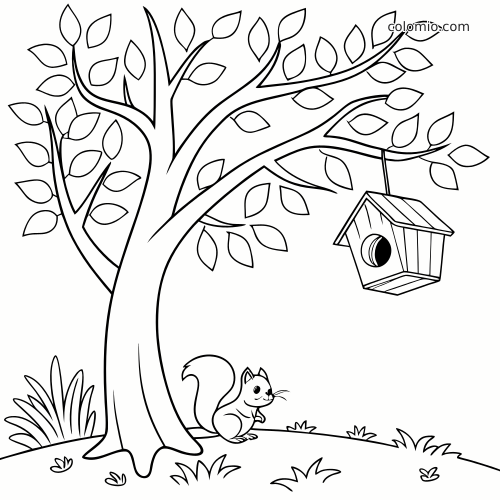
Print our free printable tree coloring pages — ready-to-print line art, no signup.
More ideas for drawing
-

Airplane drawing -

Plane drawing easy -

Apple drawing -

Bicycle drawing -

Ship drawing -

Car drawing -

Car drawing easy -

Cat drawing -

Cow drawing -

Dinosaur drawing -

Dog drawing -

Puppy drawing -

Dragon drawing -

Digger drawing -

Fairy drawing -

Giraffe drawing -

Lion drawing -

Mermaid drawing -

Moon drawing -

Motorcycle drawing -

Penguin drawing -

Pig zeichnen (einfach) -

Princess drawing -

Reindeer drawing -

Rooster drawing -

Santa Claus drawing -

Shark drawing -

Sheep drawing -

Strawberry drawing -

Sunflower drawing -

Tiger drawing -

Tractor drawing -

Train drawing -

Tree drawing -

Tree drawing easy -

Tulip drawing -

Turtle drawing -

Unicorn drawing -

Unicorn drawing easy -

Witch drawing