

Today, we will embark on a delightful journey to draw a vibrant sunflower, perfect for young artists and beginners eager to capture the beauty of nature on paper. This tutorial is ideal for kids aged 8 and up who are passionate about learning how to draw lively flowers.
We will utilize a specific technique that involves constructing the sunflower from a simple circle and radiating lines, making it easy to capture the flower’s iconic look with precision and simplicity.
What You Will Need
- A hard pencil like an HB for sketching
- A softer pencil such as 2B for detailing
- Colored pencils in yellow, green, and brown
- A clean eraser
- A sharp sharpener to keep your pencils ready
Begin by using your hard pencil to sketch light outlines that will guide your drawing. Once the basic shape is established, you can switch to a softer pencil for adding details and depth. Finally, use your colored pencils to bring the sunflower to life with vibrant hues.

Step 1: Corolla and Flower Base
Start your drawing by sketching a small circle in the center of your paper. This circle will serve as the corolla, the central part of the sunflower where the seeds are housed.
Make sure the circle is not too large, as the petals will radiate outward from this point. Keep your strokes light and gentle so you can easily adjust the size if needed.
Tip: Using a coin or a bottle cap can help you draw a perfect circle if you find it challenging.

Step 2: Tongue Flowers
Around the corolla, draw short, rounded lines that resemble small tongues. These are known as the tongue flowers, which are the tiny florets found at the core of the sunflower.
Focus on keeping these lines evenly spaced and consistent in size around the circle. They should slightly overlap the edge of your initial circle to add texture and depth.
Important detail: The tongue flowers give your sunflower its realistic texture, so take your time to make them neat and uniform.

Step 3: More Petals
Next, draw elongated oval shapes radiating from the circle’s perimeter. These ovals are the sunflower petals and should extend outward to mimic the natural spread of a sunflower.
Vary the length and angle of the petals slightly to give your sunflower a more natural and organic appearance. Some petals may slightly overlap, adding to the realism.
Tip: Visualize the sun’s rays when placing your petals to maintain a symmetrical yet natural look.

Step 4: Petals Wreath
Now, add a second layer of petals to create a full wreath effect. Draw these petals slightly behind the first layer, ensuring they are visible but not as prominent.
This second layer of petals will give your sunflower a lush and full appearance, making it look as if it’s basking in the sunlight.
Important detail: Keep the second layer more subtle with lighter strokes to distinguish it from the front petals.

Step 5: Foliage for the Stem
For the foliage, draw a long, slender stem extending from the base of your sunflower. Add a few leaves by sketching elongated, teardrop shapes along the stem.
The leaves should have a gentle curve to them, reflecting the sunflower’s natural growth patterns. Add some veins for extra detail and realism.
Tip: Make the leaves slightly different sizes and angles to emulate the natural irregularity of a sunflower’s foliage.
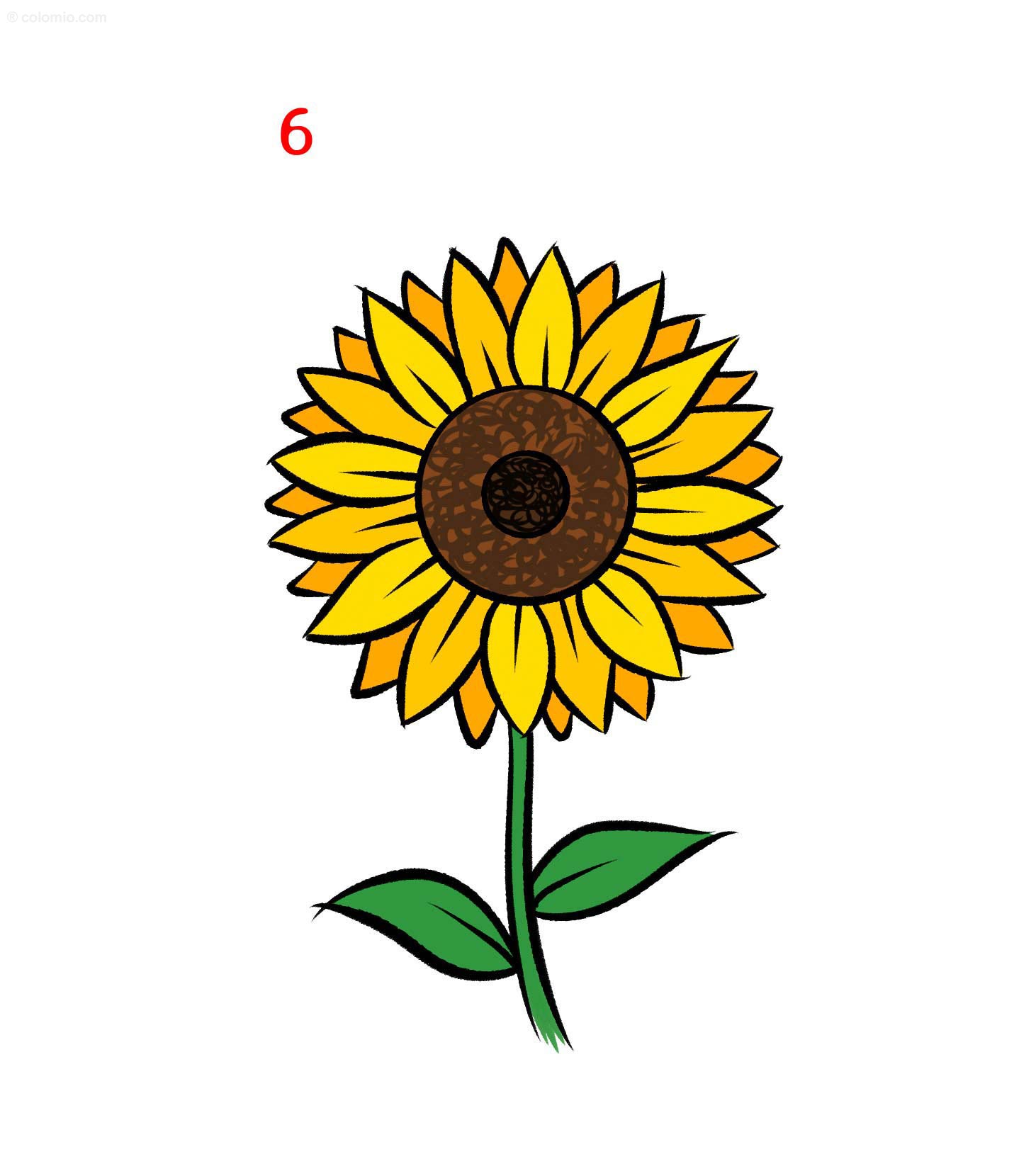
Step 6: Colorize
Start coloring your sunflower with a bright yellow for the petals. Use even strokes and vary the pressure to create a gradient from the petal base to the tip.
Add brown to the corolla to mimic the sunflower seeds, using a circular motion to fill the area evenly. For the stem and leaves, use a vibrant green, adding a touch of darker green for shading.
Important detail: Leave small areas of white on the petals for highlights, which will give your sunflower a sunlit, three-dimensional appearance.
Optional Enhancements to Try
- Add a gentle shadow beneath the sunflower using a soft gray to ground it on the paper.
- Illustrate a blue sky background to give your sunflower a cheerful, summer day setting.
- Draw a bee perched on one of the petals to enhance the scene’s liveliness.
- Incorporate a few clouds in the sky to add depth and context to your drawing.
Tips for an Even Better Sunflower Drawing
Three details turn a generic yellow flower into an unmistakable sunflower: the large dark center disk, the ring of pointed petals radiating outward, and the tall, sturdy stem with a few large heart-shaped leaves. Each one carries half the personality of the flower.
The center disk is bigger than beginners usually draw – it should take up about a third of the flower’s total diameter, sometimes more. Inside the disk, real sunflower seeds are arranged in a beautiful spiral pattern (the famous Fibonacci spiral). You don’t need to draw every spiral, but suggesting them with curving rows of small dots or tiny diamond shapes elevates the drawing instantly.
The petals are long, slightly pointed, and slightly twisted. Real sunflowers have around 30–40 ray petals, but for a drawing, 18–24 is plenty. Vary their lengths slightly – some shorter, some longer – and let one or two curl forward toward the viewer. Petals all the same length make the flower look like a child’s drawing of a sun.
The stem must be sturdy – sunflowers have thick, fuzzy green stems, sometimes the diameter of a thumb. Show this thickness with two parallel lines instead of a single thin line. Add a few small horizontal hairs along the stem for texture.
The leaves are large, heart-shaped, with a clearly visible central vein and several smaller veins branching off. They alternate up the stem rather than appearing in pairs. Two or three leaves are enough for most compositions.
Sunflower Variations & Stages
The same drawing approach captures all the life stages of a sunflower:
- Bud (closed sunflower): A pointed green bud at the top of the stem, with petals just starting to peek out. Like a tightly wrapped green football.
- Half-bloomed: Petals visible but still curved upward, not yet fully open. Center disk small and tight.
- Full bloom (the classic): Wide open petals radiating outward, large brown center disk visible, head facing the sun.
- Mature (heavy with seeds): The head is bowed forward, the petals starting to droop or fall, the seeds visible inside the disk. End-of-summer melancholy.
- Dried sunflower head: Petals gone, central disk full of mature dark seeds. Often used in autumn decoration.
- Field of sunflowers: Many flowers at different stages all together, with a horizon line and blue sky behind.
- Cartoon sunflower: Big smiling face on the center disk, eyes with eyelashes, oversized petals, simple round body. Pure children’s book joy.
- Mini sunflowers: Smaller flowers with proportionally larger disks. Great for tight bouquet illustrations.
Sunflower Scenes & Compositions
- Sunflower field at sunrise: Rows of sunflowers all turned in the same direction, golden sunlight streaming from one side, a few birds in the sky. Classic Provence vibe.
- Single bloom in a vase: A glass jar or rustic terracotta vase on a wooden table, single sunflower with three or four leaves on the stem. Quiet still life.
- Bouquet of sunflowers: Five to seven sunflowers tied together with twine or ribbon, leaves arranged around them. Gift-style composition.
- Sunflower with bee: A bumblebee hovering over the center disk or landing on a petal. Add small motion lines for the wings.
- Garden border: A row of tall sunflowers along a wooden fence with smaller flowers (daisies, marigolds) at their feet.
- Van-Gogh-style still life: Multiple sunflowers in a yellow ceramic vase, swirly brushstroke effects, post-impressionist colors. Pay homage to a master.
- Sunflower with butterfly: A bright butterfly perched on one of the petals, in contrasting colors (purple, blue) for visual pop.
- Storybook sunflower with face: Tall cartoon sunflower with a smiling face on the center disk and small leafy “arms” reaching out. Talks to the reader.
- Autumn harvest: Sunflower next to pumpkins, a wicker basket, and leaves on the ground. End-of-summer warmth.
The Center Disk: Where Most of the Magic Lives
The brown center disk is what makes a sunflower a sunflower. A few approaches:
- Realistic seed pattern: Cross-hatched diagonal lines forming a tight grid, suggesting the spiral arrangement of seeds. Mostly dark brown with a slightly lighter ring at the edge.
- Stylized dots: A field of tiny round dots in two shades (dark brown and slightly lighter golden-brown), with the dots getting smaller toward the center.
- Spiral suggestion: Two or three faint curving lines drawn outward from the center, hinting at the spiral without drawing every seed.
- Texture cross-hatching: Quick diagonal scribbles in dark brown, looser at the edges and tighter in the middle. Loose and painterly.
- Cartoon flat: Just a solid brown circle with no detail. Acceptable for very simple children’s book illustrations.
Color Palettes for Sunflowers
- Classic warm sunflower: Bright cadmium-yellow petals with darker amber-orange shadows at the base, dark chocolate-brown center, sage-green stem and leaves.
- Sunset sunflower: Mixed gold-and-orange petals (some yellow, some orange-red), deep brown center, olive-green stem. Late-season warmth.
- Van Gogh inspired: Several shades of yellow (light cream, vibrant gold, deep orange), warm earth-brown disk with hints of purple, golden-yellow background.
- Storybook bright: Pure cartoon yellow petals, soft brown center, mint-green stem, baby-blue sky behind. Friendly and clean.
- Vintage botanical: Faded mustard yellow, warm sienna brown, dusty olive green, parchment-cream background. Old-fashioned encyclopedia look.
- Modern minimalist: Single tone of yellow with no shading, flat brown disk, single line for the stem. Graphic and clean.
- Red sunflower variety: Some real cultivars (like ‘Moulin Rouge’) have deep burgundy-red petals. Striking and unusual.
Adding Realism & Personality
Small touches that elevate the drawing:
- Petals slightly curling: Two or three petals showing their underside (slightly different yellow) instead of all flat. Adds dimension.
- Drop of dew: A small clear droplet on a leaf or petal, with a tiny white highlight inside it.
- Pollen on bees: If a bee is nearby, small yellow specks of pollen on its body and falling around the flower.
- Light direction: Brighter highlights on the side facing the sun, deeper shadows on the opposite side.
- Wind direction: The whole flower head and leaves leaning slightly in one direction, suggesting a breeze.
- Falling petals: A few petals drifting in the air or on the ground – especially effective for autumn drawings.
- Stem hairs: Tiny short hairs along the stem, especially visible in close-up. Real sunflower stems are distinctly fuzzy.
Common Mistakes to Avoid
1. The center disk is too small. A tiny brown dot in the middle reads as a daisy, not a sunflower. Make the disk substantial – at least one-third the diameter of the whole flower.
2. All petals are identical. Real petals vary slightly in length and angle. Forced symmetry reads as a sun-clip-art, not a real flower.
3. The petals are too round. Sunflower petals are pointed at the tip, not rounded like daisy petals. Sharp tips = sunflower; rounded tips = daisy.
4. The stem is too thin. Sunflowers are tall, heavy plants with thick fuzzy stems. A thin stem looks like it can’t support the flower head.
5. Leaves in pairs (opposite each other). Sunflower leaves alternate up the stem, not in pairs. Pairs suggest a different plant species.
6. The center disk is plain brown. Even a hint of texture (dots, lines, or cross-hatching) instantly elevates the disk from “hole in the flower” to “living seed pattern.”
7. The flower head sits perfectly upright. Real sunflower heads almost always tilt or face one direction, often toward the sun. A perfectly upright head looks rigid and unnatural.
Frequently Asked Questions About Drawing a Sunflower
How do I make the petals look more realistic?
Vary the length and angle of each petal slightly. Adding subtle curves and overlaps can enhance the natural appearance of your sunflower petals.
What colors should I use for the tongue flowers?
The tongue flowers are typically a dark brown to black in real sunflowers, reflecting their seed-like nature. Consider using a dark brown colored pencil for authenticity.
How can I create a sense of depth in my sunflower drawing?
Use shading techniques, such as adding darker tones where petals overlap and lighter tones where they catch the light, to give your drawing a three-dimensional feel.
What is the best way to draw symmetrical petals?
Sketch light guide lines radiating from the circle’s center, like the spokes of a wheel, to help you place the petals symmetrically around the flower.
How do I add texture to the corolla?
Use small, circular motions with your pencil to mimic the texture of sunflower seeds. Layering different shades of brown can also add depth.
Should the leaves be the same color as the stem?
While the leaves and stem are generally green, using slightly different shades can add realism. Leaves often have more variation, so a mix of green hues will enhance your drawing.
Your Sunflower Drawing Is Complete!
Congratulations on completing your sunflower drawing! You’ve mastered the technique of using circles and radiating lines to capture the iconic shape of this beloved flower.
Now that you’ve learned how to draw a sunflower, why not try your hand at other floral tutorials? Each one will teach you new techniques and help you expand your artistic skills.
More Sunflower Templates


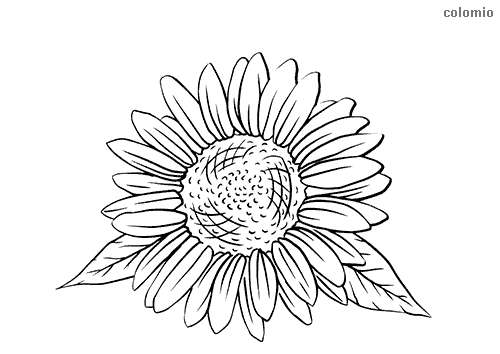
Take a picture and send it to [email protected] – we publish it on www.colomio.com!
All tutorials and images are copyrighted by happycolorz GmbH. Interested in using it? Please send a mail to [email protected].
More ideas for drawing
-

Airplane drawing -

Plane drawing easy -

Apple drawing -

Bicycle drawing -

Ship drawing -

Car drawing -

Car drawing easy -

Cat drawing -

Cow drawing -

Dinosaur drawing -

Dog drawing -

Puppy drawing -

Dragon drawing -

Digger drawing -

Fairy drawing -

Giraffe drawing -

Lion drawing -

Mermaid drawing -

Moon drawing -

Motorcycle drawing -

Penguin drawing -

Pig zeichnen (einfach) -

Princess drawing -

Reindeer drawing -

Rooster drawing -

Santa Claus drawing -

Shark drawing -

Sheep drawing -

Strawberry drawing -

Sunflower drawing -

Tiger drawing -

Tractor drawing -

Train drawing -

Tree drawing -

Tree drawing easy -

Tulip drawing -

Turtle drawing -

Unicorn drawing -

Unicorn drawing easy -

Witch drawing
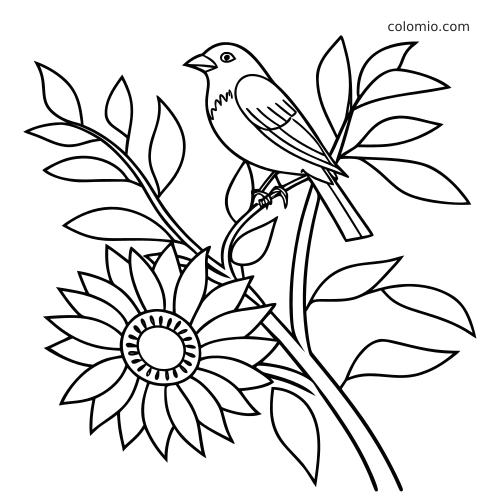
Print our free printable sunflower coloring pages — ready-to-print line art, no signup.