

|
||||
|---|---|---|---|---|
| Free Download | ||||
|
|
|
|||

Today, we’re going to draw a playful cat, perfect for kids and beginners who love animals. This tutorial will guide you through each step of creating a simple yet charming cat portrait, focusing on its unique features like the adorable whiskers and flicking tail.
Our approach uses a simple framework of overlapping shapes to capture the cat’s form and posture. This technique will help you understand basic animal anatomy and proportion, making your drawing look natural and lively.
What You Will Need
- A sheet of white drawing paper
- Hard pencil (HB) for initial outlines
- Soft pencil (2B) for final lines and details
- Colored pencils in gray, orange, and green for realistic coloring
- A good quality eraser for clean corrections
Start by using the hard pencil to sketch the basic shapes, which will act as your guide lines. Once you’re satisfied with the layout, switch to the soft pencil to refine these lines, adding depth and detail. Finally, use your colored pencils to bring the drawing to life.

Step 1: The Head
Begin with a large circle slightly above the center of your paper to represent the cat’s head. This circle will be the foundation for the cat’s facial features and ears.
Drawing the head first gives your cat a focal point. Ensure the circle is proportional to the size you envision for your cat’s body, as this will guide the rest of your drawing.
Tip: Keep your lines light so that they can be easily erased and adjusted if necessary.

Step 2: The Torso of the Cat
Next, draw an oval shape overlapping the bottom of the head circle. This will form the cat’s torso and help define its posture.
By overlapping the oval with the circle, you create a natural basis for the cat’s neck and shoulders. This step ensures your cat’s body has a realistic flow from head to torso.

Step 3: Legs and Tail
For the legs, sketch two straight lines extending down from the torso, each line ending with a small oval for paws. Add a long curved line from the rear to form the tail.
The legs should be of equal length and the tail should curve in a natural, relaxed position. This step helps in refining the cat’s standing position and maintaining balance.

Step 4: First Permanent Contours
Now, use the soft pencil to trace over the head and torso, adding definition to the shapes. Begin to outline the ears by drawing two triangles on top of the head.
Make sure the triangles are symmetrical and proportionate to the head. This step adds clarity and structure to your initial sketch.

Step 5: Final Lines for Legs and Tail
Refine the legs and tail by adding curves to represent the natural muscle tone. Ensure the paws are rounded and not too sharp.
Focus on smooth, flowing lines to depict the cat’s agile and graceful nature. This additional detail emphasizes the cat’s physical characteristics.

Step 6: The Face
Draw the cat’s face by adding almond-shaped eyes, a small triangle for the nose, and a line for the mouth. Add whiskers extending from each cheek.
Position the eyes symmetrically and ensure the nose is centered. The whiskers should be long and evenly spaced, giving your cat expression and personality.
Important detail: Leave small highlights in the eyes to make them appear shiny and lively.

Step 7: Removing the Guides
Erase the guide lines gently, leaving only the refined outlines. Make sure no sketchy lines are visible, which could distract from the finished look.
This step is crucial for a polished result. Use a clean eraser to avoid smudges on your paper.

Step 8: Coloring
Begin coloring with a gray pencil, filling in the body of the cat. Use orange for highlights or spots if you want a tabby look.
For the eyes, use green to give them a piercing, lively look. Vary your pressure to create depth, pressing lighter in areas that catch the light.
Important detail: Leave the tip of the nose and the inner ears in a lighter shade or white to mimic the natural pink tint seen in cats.
Optional Enhancements to Try
- Add a soft shadow under the cat using a light gray pencil to anchor it to the ground.
- Draw a collar with a tag to give your cat some personality.
- Include a background like a cozy living room or a sunny garden for context.
- Add color variations to the fur, such as light stripes or patches, for a more realistic look.
Tips for an Even Better Cat Drawing
Three small details separate a believable cat from a generic furry blob: the shape and position of the ears, the vertical slit pupils, and the set of long whiskers. Spend an extra minute on each of these and the whole drawing instantly becomes “cat.”
The ears are tall, triangular, and set wide apart at the top of the head – almost at the corners. They should never sit on top like a teddy bear’s. Each ear has a small inner triangle (the inner ear) drawn in a slightly pinker shade. A small tuft of fur on the inside, especially for breeds like Maine Coons, is a great extra detail.
The eyes are large, almond-shaped, and tilted slightly upward at the outer corners. Inside each eye, the iris is a colorful oval (green, gold, blue, or amber), and the pupil is a thin vertical slit when alert – or a wider oval in dim light. Round dot pupils make a cat look like a cartoon dog. Add a small white highlight in each eye for life.
The whiskers are not optional. Real cats have 6–8 long whiskers on each side of the snout, plus shorter ones above the eyes. Draw them as gentle curving lines, not perfectly straight, with most pointing forward. Skipping the whiskers is the fastest way to make a cat look incomplete.
The body is built on simple ovals: a round head, a slightly elongated body, and four legs that taper to small paws. The tail is the cat’s expressive tool – long, flexible, and almost as long as the body itself.
Cat Breed Variations
The same body plan adapts to a huge variety of cat breeds:
- Tabby (the universal cat): Striped pattern in brown, grey, or orange; the iconic “M” mark on the forehead; medium-length fur. The most familiar cat appearance.
- Siamese: Slim elegant body, cream-colored fur with darker brown points on the ears, face, paws, and tail. Striking blue almond eyes.
- Persian: Round flat face, short pushed-in nose, very long fluffy fur, large round eyes. Looks like a living teddy bear.
- Maine Coon: Massive size, long fluffy fur, ear tufts (lynx-like points), bushy tail. The gentle giant of cats.
- Black cat: Solid black coat, glowing yellow or green eyes. Halloween classic and elegant year-round.
- Calico: White base with random patches of orange and black. No two calicos are alike.
- Sphynx (hairless): Wrinkled hairless skin, oversized triangular ears, large lemon-shaped eyes. Otherworldly looking.
- British Shorthair: Round chubby face, dense plush fur (often grey-blue), copper-orange eyes, sturdy build.
- Ragdoll: Large semi-long-haired cat with point coloring (like Siamese but fluffier), striking blue eyes, often drawn relaxed and floppy.
- Kitten: Smaller body with proportionally bigger head and eyes, oversized paws, tiny tail. Universal cuteness.
Pose Variations
A standing cat is fine, but cats are masters of expressive postures:
- The classic loaf: Cat sitting with all four legs tucked under the body, looking like a perfect bread loaf. The most beloved cat pose.
- Sitting tall: Cat upright with front legs straight, tail curled around the front feet. Dignified and alert.
- Sleeping curled up: Cat in a tight circle, tail wrapped around to touch the nose, eyes closed. Pure peace.
- Stretching: Cat with front paws extended forward, back arched, rear up high. The classic morning stretch.
- Pouncing: Cat low to the ground, eyes wide and locked on prey, tail held still or twitching at the tip. Mid-action drama.
- Mid-jump: All four paws off the ground, body extended horizontally, eyes wide. Captures motion.
- Belly-up trust: Cat lying on its back with all four paws relaxed in the air, totally vulnerable. The ultimate “I trust you” pose.
- Watching from above: Cat perched on a high shelf or fridge, looking down at the viewer with mysterious confidence.
- Halloween Halloween arch: Black cat with arched back, fur on end, hissing. Classic spooky pose.
Scene Compositions
- Cat with yarn ball: Kitten chasing or batting at a colorful ball of yarn that’s unraveling across the floor. Pure storybook charm.
- On the windowsill: Cat sitting at a window watching birds outside, with rain or sunshine making different moods.
- In a cardboard box: Cat squeezed into an obviously-too-small box with only the head and tail visible. The internet’s favorite cat scene.
- Cat & mouse: Cat crouched and stalking a tiny mouse in front of a hole in the wall. Tom-and-Jerry style.
- Sleeping with a person: Cat curled up next to or on top of a sleeping human. Heartwarming.
- On the laptop keyboard: Cat lying directly on a laptop, blocking the screen. Working-from-home reality.
- With a bowl of milk: Cat lapping at a small bowl of milk, with its tail curled gracefully behind. Vintage storybook.
- Halloween with witch: Black cat sitting next to a witch’s broom and hat. Spooky season magic.
- Cat in a basket: Cat curled inside a wicker basket with a soft blanket. Cozy and content.
Color Palettes for Cats
- Classic orange tabby: Warm orange-and-cream stripes, white belly and paws, green or amber eyes, pink nose.
- Grey tabby: Cool silver-grey with darker grey stripes, white chest, yellow-gold eyes.
- Black cat with green eyes: Deep matte black fur with subtle violet undertones in shadow, glowing emerald-green eyes, dark pink nose.
- Siamese point-coloring: Cream body, chocolate-brown points on face/ears/paws, vivid sapphire-blue eyes, pink-grey nose.
- Storybook white kitten: Pure white with light grey shading, baby-pink nose and inner ears, sparkling sky-blue eyes, oversized eyelashes.
- Calico: Pure white base with bold orange patches and black patches, green eyes, pink-and-black nose. No symmetry – the more random, the better.
- Halloween black cat: Pure black silhouette, glowing yellow eyes, hint of orange backlight from a jack-o-lantern.
Adding Personality to Your Cat
Tiny touches that bring the cat to life:
- Asymmetric ears: One ear slightly tilted forward and the other back – suggests a cat that’s actively listening.
- Tail position: Upright tail with a curl at the top means happy. Puffed-up tail means scared. Tail tucked means submissive. Tip twitching means annoyed.
- The slow blink: Half-closed eyes with the corners curving up – a contented cat “smiling.”
- A tiny pink tongue tip: Sticking out slightly between the lips – instantly endearing (“blep” in cat language).
- One paw raised: Like a Japanese maneki-neko, suggests playfulness or greeting.
- Eyes following the viewer: Both pupils slightly off-center toward you – the cat is watching you.
- Visible toe beans: The pink pads of the paws when the cat is stretching or lying belly-up. Universally beloved.
Common Mistakes to Avoid
1. Round dot pupils. Cats have vertical slit pupils when alert. Round black dots make the eyes look like a cartoon dog or owl.
2. Ears placed too low or in the middle. Cat ears must sit at the very corners of the top of the head, never in the middle. Low-placed ears look like a bear.
3. Forgetting the whiskers. A whiskerless cat looks shaved or alien. Always add at least 4–6 long whiskers per side.
4. The tail is too short or too thick. Cat tails are nearly as long as the body and proportionally slim – never short stubs (unless you’re drawing a Manx).
5. The legs are too straight. Cats have a slight bend at the “ankle” (hock) on the back legs. Perfectly straight legs look stiff and dog-like.
6. The face is too symmetric. Real cats almost always look slightly off-center – one eye half-closed, ears at different angles, head tilted. Forced symmetry feels lifeless.
7. No fur direction. Even short fur has a clear flow direction – from head down the back to the tail, and from the spine outward toward the belly. Cross-hatching everything in random directions reads as fur fail.
Frequently Asked Questions About Drawing a Cat
How do I make the cat’s fur look realistic?
Use short, light strokes with your pencil to mimic the texture of fur. Layer different shades for depth and dimension.
What if my cat’s ears look uneven?
Check the symmetry of your triangles and adjust them. Use your eraser to reshape any uneven areas gently.
How can I make the eyes more expressive?
Ensure the pupils are centered and add highlights. Experiment with the size of the pupils to convey different moods.
My whiskers don’t look right. What should I do?
Draw whiskers with a quick, confident stroke for a natural look. Ensure they fan outward from the cat’s cheeks evenly.
What colors are best for a tabby cat?
Use a combination of gray and orange, adding darker stripes or spots for texture. Layer colors lightly to blend naturally.
How can I keep my lines from smudging?
Work from left to right if you’re right-handed (and vice versa) to avoid dragging your hand across the paper. Use a fixative spray to preserve your drawing.
Your Cat Drawing Is Complete!
Congratulations on completing your cat drawing! You’ve learned how to use overlapping shapes to create a realistic and charming feline friend.
Now that you’ve mastered this technique, try exploring our other tutorials. Each one is designed to enhance your skills and inspire your creativity.
More Cat Templates

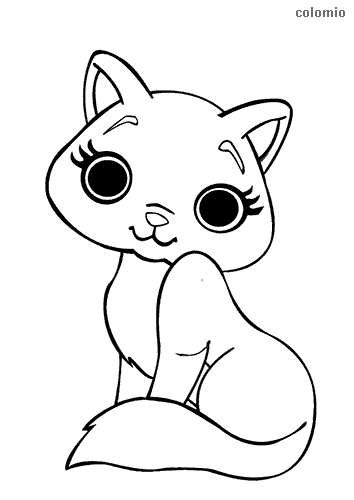

Take a picture and send it to show@colomio.com – we publish it on www.colomio.com!
All tutorials and images are copyrighted by happycolorz GmbH. Interested in using it? Please send a mail to info@colomio.com.
More ideas for drawing
-

Airplane drawing -

Plane drawing easy -

Apple drawing -

Bicycle drawing -

Ship drawing -

Car drawing -

Car drawing easy -
Cat drawing -

Cow drawing -

Dinosaur drawing -

Dog drawing -

Puppy drawing -

Dragon drawing -

Digger drawing -

Fairy drawing -

Giraffe drawing -

Lion drawing -

Mermaid drawing -

Moon drawing -

Motorcyle drawing -

Penguin drawing -

Pig zeichnen (einfach) -

Princess drawing -

Reindeer drawing -

Rooster drawing -

Santa Claus drawing -

Shark drawing -

Sheep drawing -

Strawberry drawing -

Sunflower drawing -

Tiger drawing -

Tractor drawing -

Train drawing -

Tree drawing -

Tree drawing easy -

Tulip drawing -

Turtle drawing -

Unicorn drawing -

Unicorn drawing easy -

Witch drawing
More Crafting Ideas
-

Bee craft -

How to Make a Paper Boat -

How to make an envelope -

Ladybug Craft -
Origami Boat -

Butterfly Craft